


Page 420 - ACCCN's Critical Care Nursing
P. 420
Ventilation and Oxygenation Management 397


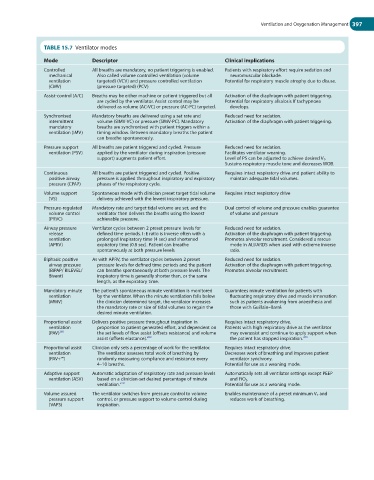
               TABLE 15.7  Ventilator modes

               Mode            Descriptor                                  Clinical implications
               Controlled      All breaths are mandatory, no patient triggering is enabled.   Patients with respiratory effort require sedation and
                 mechanical      Also called volume controlled ventilation (volume   neuromuscular blockade.
                 ventilation     targeted) (VCV) and pressure controlled ventilation   Potential for respiratory muscle atrophy due to disuse.
                 (CMV)           (pressure targeted) (PCV)
               Assist-control (A/C)  Breaths may be either machine or patient triggered but all   Activation of the diaphragm with patient triggering.
                                 are cycled by the ventilator. Assist control may be   Potential for respiratory alkalosis If tachypnoea
                                 delivered as volume (AC-VC) or pressure (AC-PC) targeted.  develops.
               Synchronised    Mandatory breaths are delivered using a set rate and   Reduced need for sedation.
                 intermittent    volume (SIMV-VC) or pressure (SIMV-PC). Mandatory   Activation of the diaphragm with patient triggering.
                 mandatory       breaths are synchronised with patient triggers within a
                 ventilation (IMV)  timing window. Between mandatory breaths the patient
                                 can breathe spontaneously.
               Pressure support   All breaths are patient triggered and cycled. Pressure   Reduced need for sedation.
                 ventilation (PSV)  applied by the ventilator during inspiration (pressure   Facilitates ventilator weaning.
                                 support) augments patient effort.         Level of PS can be adjusted to achieve desired V T .
                                                                           Sustains respiratory muscle tone and decreases WOB.
               Continuous      All breaths are patient triggered and cycled. Positive   Requires intact respiratory drive and patient ability to
                 positive airway   pressure is applied throughout inspiratory and expiratory   maintain adequate tidal volumes.
                 pressure (CPAP)  phases of the respiratory cycle.
               Volume support   Spontaneous mode with clinician preset target tidal volume   Requires intact respiratory drive
                 (VS)            delivery achieved with the lowest inspiratory pressure.
               Pressure-regulated   Mandatory rate and target tidal volume are set, and the   Dual control of volume and pressure enables guarantee
                 volume control   ventilator then delivers the breaths using the lowest   of volume and pressure
                 (PRVC)          achievable pressure.
               Airway pressure   Ventilator cycles between 2 preset pressure levels for   Reduced need for sedation.
                 release         defined time periods. I : E ratio is inverse often with a   Activation of the diaphragm with patient triggering.
                 ventilation     prolonged Inspiratory time (4 sec) and shortened   Promotes alveolar recruitment. Considered a rescue
                 (APRV)          expiratory time (0.8 sec). Patient can breathe   mode in ALI/ARDS when used with extreme inverse
                                 spontaneously at both pressure levels      ratio.
               Biphasic positive   As with APRV, the ventilator cycles between 2 preset   Reduced need for sedation.
                 airway pressure   pressure levels for defined time periods and the patient   Activation of the diaphragm with patient triggering.
                 (BiPAP/ BILEVEL/  can breathe spontaneously at both pressure levels. The   Promotes alveolar recruitment.
                 Bivent)         inspiratory time is generally shorter than, or the same
                                 length, as the expiratory time.
               Mandatory minute   The patient’s spontaneous minute ventilation is monitored   Guarantees minute ventilation for patients with
                 ventilation     by the ventilator. When the minute ventilation falls below   fluctuating respiratory drive and muscle innervation
                 (MMV)           the clinician determined target, the ventilator increases   such as patients awakening from anaesthesia and
                                 the mandatory rate or size of tidal volumes to regain the   those with Guillain–Barré.
                                 desired minute ventilation.
               Proportional assist   Delivers positive pressure throughout inspiration in   Requires intact respiratory drive.
                 ventilation     proportion to patient generated effort, and dependent on   Patients with high respiratory drive as the ventilator
                 (PAV) 269       the set levels of flow assist (offsets resistance) and volume   may overassist and continue to apply support when
                                 assist (offsets elastance). 268            the patient has stopped inspiration. 269
               Proportional assist   Clinician only sets a percentage of work for the ventilator.   Requires intact respiratory drive.
                 ventilation     The ventilator assesses total work of breathing by   Decreases work of breathing and improves patient
                 (PAV+™)         randomly measuring compliance and resistance every   ventilator synchrony.
                                 4–10 breaths.                             Potential for use as a weaning mode.
               Adaptive support   Automatic adaptation of respiratory rate and pressure levels   Automatically sets all ventilator settings except PEEP
                 ventilation (ASV)  based on a clinician-set desired percentage of minute   and FiO 2 .
                                 ventilation. 270                          Potential for use as a weaning mode.
               Volume assured   The ventilator switches from pressure control to volume   Enables maintenance of a preset minimum V T and
                 pressure support   control, or pressure support to volume control during   reduces work of breathing.
                 (VAPS)          inspiration.

