


Page 438 - ACCCN's Critical Care Nursing
P. 438
Neurological Assessment and Monitoring 415

                            Brain
                                                      CENTRAL            Higher-order functions
                                                      NERVOUS           such as memory, learning
                                                                           and intelligence
                       Cranial nerves                 SYSTEM
                                                                             Information
                     Spinal cord                                             processing
                 Spinal nerves                                  Sensory                 Motor
                                                                information            commands
                                                                  with                   with
                                                                 afferent               efferent
                                                                 division               division
                                                                                includes
                                                       PERIPHERAL
                                                       NERVOUS
                                                       SYSTEM
                                                                                    Somatic    Autonomic
                                                                                    nervous   nervous system
                                                                                    system

                                                                                       Parasympathetic  Sympathetic
                                                                                          division    division

                                                        Special sensory  Somatic sensory
                                                         receptors   receptors monitor
                                                       provide sensations  skeletal muscles,     Smooth
                                                        of smell, taste  joints, skin surface;  Skeletal  muscle
                                                       vision, balance and  provide position sense  muscle
                                                          hearing   and touch, pressure,
                                                                    pain and temperature         Cardiac
                                                                       sensations                muscle
                                                                                                 Glands
                                                          Visceral sensory receptors monitor
                                                          internal organs, including those of
                                                         cardiovascular, respiratory, digestive,
                                                          urinary and reproductive systems
                                                             RECEPTORS                    EFFECTORS
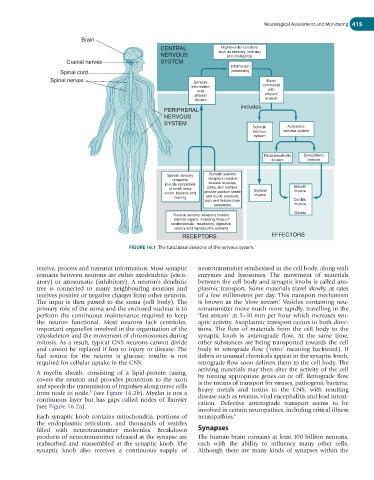
                                           FIGURE 16.1  The functional divisions of the nervous system.   1


             receive, process and transmit information. Most synaptic   neurotransmitter synthesised in the cell body, along with
             contacts between neurons are either axodendritic (excit-  enzymes  and  lysosomes.  The  movement  of  materials
             atory)  or  axosomatic  (inhibitory).  A  neuron’s  dendritic   between the cell body and synaptic knobs is called axo-
             tree  is  connected  to  many  neighbouring  neurons  and   plasmic transport. Some materials travel slowly, at rates
             receives positive or negative charges from other neurons.   of a few millimetres per day. This transport mechanism
             The  input  is  then  passed  to  the  soma  (cell  body).  The   is  known  as  the  ‘slow  stream.’  Vesicles  containing  neu-
             primary role of the soma and the enclosed nucleus is to   rotransmitter move much more rapidly, travelling in the
             perform  the  continuous  maintenance  required  to  keep   ‘fast stream’ at 5–10 mm per hour which increases syn-
             the  neuron  functional.  Most  neurons  lack  centrioles,   aptic activity. Axoplasmic transport occurs in both direc-
             important organelles involved in the organisation of the   tions.  The  flow  of  materials  from  the  cell  body  to  the
             cytoskeleton and the movement of chromosomes during   synaptic  knob  is  anterograde  flow.  At  the  same  time,
             mitosis. As a result, typical CNS neurons cannot divide   other substances are being transported towards the cell
             and cannot be replaced if lost to injury or disease. The   body  in  retrograde  flow  (’retro’  meaning  backward).  If
             fuel  source  for  the  neuron  is  glucose;  insulin  is  not   debris or unusual chemicals appear in the synaptic knob,
             required for cellular uptake in the CNS.             retrograde flow soon delivers them to the cell body. The
                                                                  arriving materials may then alter the activity of the cell
             A  myelin  sheath,  consisting  of  a  lipid-protein  casing,
             covers the neuron and provides protection to the axon   by turning appropriate genes on or off. Retrograde flow
             and speeds the transmission of impulses along nerve cells   is the means of transport for viruses, pathogenic bacteria,
             from node to node.  (see Figure 16.2b). Myelin is not a   heavy  metals  and  toxins  to  the  CNS,  with  resulting
                              3
             continuous  layer  but  has  gaps  called  nodes  of  Ranvier   disease such as tetanus, viral encephalitis and lead intoxi-
             (see Figure 16.2a).                                  cation.  Defective  anterograde  transport  seems  to  be
                                                                  involved in certain neuropathies, including critical illness
             Each synaptic knob contains mitochondria, portions of   neuropathies. 4
             the  endoplasmic  reticulum,  and  thousands  of  vesicles
             filled  with  neurotransmitter  molecules.  Breakdown    Synapses
             products of neurotransmitter released at the synapse are   The human brain contains at least 100 billion neurons,
             reabsorbed  and  reassembled  at  the  synaptic  knob.  The   each  with  the  ability  to  influence  many  other  cells.
             synaptic  knob  also  receives  a  continuous  supply  of   Although  there  are  many  kinds  of  synapses  within  the

