


Page 439 - ACCCN's Critical Care Nursing
P. 439
416  P R I N C I P L E S   A N D   P R A C T I C E   O F   C R I T I C A L   C A R E

                                                                                     Dendrite

                                                                                         Nucleolus


                                                        Axon
                                                        hillock                           Nucleus


                                                   Initial segment                        Nissl bodies
                   Free nerve
                 endings in skin                     Oligodendroglial
                     Schwann cell                    cell myelin                               Axon
                          myelin                             CNS                                 Myelin
                                                                                                 sheath
                    Node of Ranvier                          PNS

                       Afferent cell body                                                       Nucleus of
                   in dorsal root ganglion                                                       Schwann
                                                                                                   cell
                 Nucleolus
                   Nucleus                            Schwann cell myelin

                     Nissl
                   bodies                    PNS
                                             CNS
                 Oligodendroglial
                      cell myelin


                          Synaptic                                                     Neuromuscular
                A         terminals                     B    Muscle fibre              junction
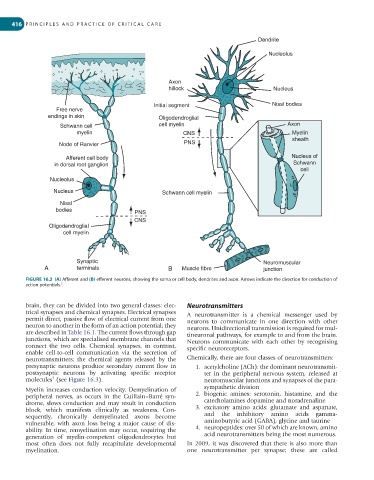
         FIGURE 16.2  (A) Afferent and (B) efferent neurons, showing the soma or cell body, dendrites and axon. Arrows indicate the direction for conduction of
         action potentials.   3


         brain, they can be divided into two general classes: elec-  Neurotransmitters
         trical synapses and chemical synapses. Electrical synapses   A  neurotransmitter  is  a  chemical  messenger  used  by
         permit direct, passive flow of electrical current from one   neurons  to  communicate  in  one  direction  with  other
         neuron to another in the form of an action potential; they   neurons. Unidirectional transmission is required for mul-
         are described in Table 16.1. The current flows through gap   tineuronal pathways, for example to and from the brain.
         junctions, which are specialised membrane channels that   Neurons  communicate  with  each  other  by  recognising
         connect  the  two  cells.  Chemical  synapses,  in  contrast,   specific neuroreceptors.
         enable  cell-to-cell  communication  via  the  secretion  of
         neurotransmitters;  the  chemical  agents  released  by  the   Chemically, there are four classes of neurotransmitters:
         presynaptic neurons produce secondary current flow in   1.  acetylcholine (ACh): the dominant neurotransmit-
         postsynaptic  neurons  by  activating  specific  receptor    ter  in  the  peripheral  nervous  system,  released  at
         molecules  (see Figure 16.3).                              neuromuscular junctions and synapses of the para-
                  5
         Myelin increases conduction velocity. Demyelination of     sympathetic division
         peripheral  nerves,  as  occurs  in  the  Guillain–Barré  syn-  2.  biogenic  amines:  serotonin,  histamine,  and  the
         drome, slows conduction and may result in conduction       catecholamines dopamine and noradrenaline
         block,  which  manifests  clinically  as  weakness.  Con-  3.  excitatory  amino  acids:  glutamate  and  aspartate,
         sequently,  chronically  demyelinated  axons  become       and  the  inhibitory  amino  acids  gamma-
         vulnerable,  with  axon  loss  being  a  major  cause  of  dis-  aminobutyric acid (GABA), glycine and taurine
         ability. In time, remyelination may occur, requiring the   4.  neuropeptides: over 50 of which are known, amino
         generation  of  myelin-competent  oligodendrocytes  but    acid neurotransmitters being the most numerous.
         most  often  does  not  fully  recapitulate  developmental   In 2009, it was discovered that there is also more than
         myelination.                                         one  neurotransmitter  per  synapse;  these  are  called

