


Page 440 - ACCCN's Critical Care Nursing
P. 440
Neurological Assessment and Monitoring 417


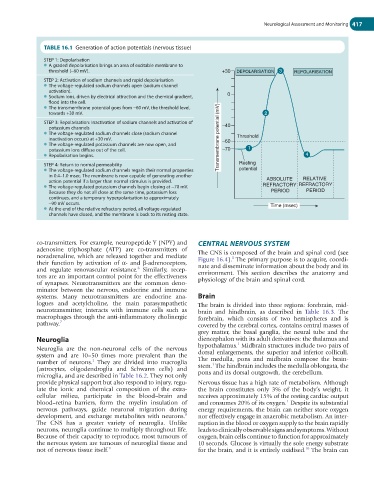
               TABLE 16.1  Generation of action potentials (nervous tissue)

               STEP 1: Depolarisation
               ●  A graded depolarisation brings an area of excitable membrane to
                 threshold (−60 mV).                                      +30  DEPOLARISATION  3  REPOLARISATION
               STEP 2: Activation of sodium channels and rapid depolarisation
               ●  The voltage-regulated sodium channels open (sodium channel
                 activation).
               ●  Sodium ions, driven by electrical attraction and the chemical gradient,   0
                 flood into the cell.
               ●  The transmembrane potential goes from −60 mV, the threshold level,
                 towards +30 mV.                                                        2
               STEP 3: Repolarisation: Inactivation of sodium channels and activation of
                 potassium channels                                       −40
               ●  The voltage-regulated sodium channels close (sodium channel   Threshold
                 inactivation occurs) at +30 mV.                         Transmembrane potential (mV)  −60
               ●  The voltage-regulated potassium channels are now open, and
                 potassium ions diffuse out of the cell.                  −70     1
               ●  Repolarisation begins.                                                             4
               STEP 4: Return to normal permeability                           Resting
               ●  The voltage-regulated sodium channels regain their normal properties   potential
                 in 0.4–1.0 msec. The membrane is now capable of generating another
                 action potential if a larger than normal stimulus is provided.         ABSOLUTE    RELATIVE
               ●  The voltage-regulated potassium channels begin closing at −70 mV.    REFRACTORY  REFRACTORY
                 Because they do not all close at the same time, potassium loss           PERIOD     PERIOD
                 continues, and a temporary hyperpolarisation to approximately
                 −90 mV occurs.                                                           Time (msec)
               ●  At the end of the relative refractory period, all voltage-regulated
                 channels have closed, and the membrane is back to its resting state.


             co-transmitters. For example, neuropeptide Y (NPY) and   CENTRAL NERVOUS SYSTEM
             adenosine  triphosphate  (ATP)  are  co-transmitters  of   The CNS is composed of the brain and spinal cord (see
             noradrenaline, which are released together and mediate   Figure 16.4).  The primary purpose is to acquire, coordi-
                                                                             5
             their  function  by  activation  of  α-  and  β-adrenoceptors,   nate and disseminate information about the body and its
             and  regulate  renovascular  resistance.   Similarly,  recep-  environment.  This  section  describes  the  anatomy  and
                                              6
             tors are an important control point for the effectiveness   physiology of the brain and spinal cord.
             of  synapses.  Neurotransmitters  are  the  common  deno-
             minator  between  the  nervous,  endocrine  and  immune
             systems.  Many  neurotransmitters  are  endocrine  ana-  Brain
             logues  and  acetylcholine,  the  main  parasympathetic   The brain is divided into three regions: forebrain, mid-
             neurotransmitter,  interacts  with  immune  cells  such  as   brain  and  hindbrain,  as  described  in  Table  16.3.  The
             macrophages through the anti-inflammatory cholinergic   forebrain,  which  consists  of  two  hemispheres  and  is
             pathway. 7                                           covered by the cerebral cortex, contains central masses of
                                                                  grey  matter,  the  basal  ganglia,  the  neural  tube  and  the
             Neuroglia                                            diencephalon with its adult derivatives: the thalamus and
                                                                               1
             Neuroglia  are  the  non-neuronal  cells  of  the  nervous   hypothalamus.  Midbrain structures include two pairs of
             system  and  are  10–50  times  more  prevalent  than  the   dorsal enlargements, the superior and inferior colliculi.
             number  of  neurons.   They  are  divided  into  macroglia   The  medulla,  pons  and  midbrain  compose  the  brain-
                               1
                                                                      1
             (astrocytes,  oligodendroglia  and  Schwann  cells)  and   stem.  The hindbrain includes the medulla oblongata, the
             microglia, and are described in Table 16.2. They not only   pons and its dorsal outgrowth, the cerebellum.
             provide physical support but also respond to injury, regu-  Nervous tissue has a high rate of metabolism. Although
             late  the  ionic  and  chemical  composition  of  the  extra-  the  brain  constitutes  only  3%  of  the  body’s  weight,  it
             cellular  milieu,  participate  in  the  blood–brain  and   receives approximately 15% of the resting cardiac output
                                                                                               1
             blood–retina  barriers,  form  the  myelin  insulation  of   and consumes 20% of its oxygen.  Despite its substantial
             nervous  pathways,  guide  neuronal  migration  during   energy requirements, the brain can neither store oxygen
                                                              8
             development, and exchange metabolites with neurons.    nor effectively engage in anaerobic metabolism. An inter-
             The  CNS  has  a  greater  variety  of  neuroglia.  Unlike   ruption in the blood or oxygen supply to the brain rapidly
             neurons, neuroglia continue to multiply throughout life.   leads to clinically observable signs and symptoms. Without
             Because of their capacity to reproduce, most tumours of   oxygen, brain cells continue to function for approximately
             the nervous system are tumours of neuroglial tissue and   10 seconds. Glucose is virtually the sole energy substrate
                                                                                                     10
             not of nervous tissue itself. 9                      for the brain, and it is entirely oxidised.  The brain can

