


Page 441 - ACCCN's Critical Care Nursing
P. 441
418  P R I N C I P L E S   A N D   P R A C T I C E   O F   C R I T I C A L   C A R E


                                                                   Myelin  2


                                                                           An action potential invades
                                                                           the presynaptic terminal


              1 Transmitter is synthesised                                3 Depolarisation of presynaptic
                and then stored in vesicles                                 terminal causes opening of
                                                                                        2+
                                                                            voltage-gated Ca  channels


                                                                                    4 Influx of Ca 2+
                                                                                      through channels


                                                     Synaptic
                                                     vesicle
                                                                                           2+
                                                                                       5 Ca causes vesicles to fuse
                                                                                         with presynaptic membrane
                                                            Transmitter
                                                            molecules
              10  Retrieval of vesicular                                              Ca 2+
                 membrane from plasma
                 membrane                                                                  6 Transmitter is released
                                                                                            into synaptic cleft via
                                                                                            exocytosis
                                                                                                      Across
                                                                                                      dendrite


                                                                                 Transmitter
                                                                                   molecules


                                                                   Transmitter                    Postsynaptic
                                                      Ions         receptor                       current flow
                                                                             7 Transmitter binds tp
                              9  Postsynaptic current causes  8 Opening or closing of  receptor molecules in
                                 excitatory or inhibitory  postsynaptic channels  postsynaptic membrane
                                 postsynaptic potential that
                                 changes the excitability of
                                 the postsynaptic cell

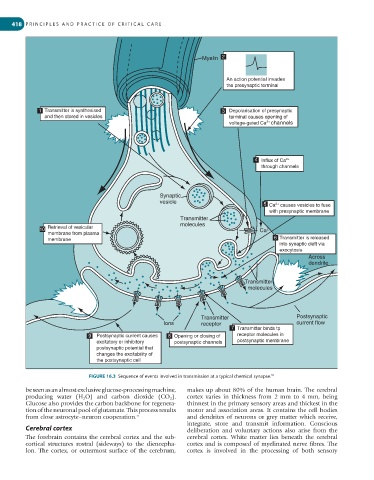
                              FIGURE 16.3  Sequence of events involved in transmission at a typical chemical synapse.
                                                                                          82
         be seen as an almost exclusive glucose-processing machine,   makes up about 80% of the human brain. The cerebral
         producing  water  (H 2 O)  and  carbon  dioxide  (CO 2 ).   cortex  varies  in  thickness  from  2 mm  to  4 mm,  being
         Glucose also provides the carbon backbone for regenera-  thinnest in the primary sensory areas and thickest in the
         tion of the neuronal pool of glutamate. This process results   motor and association areas. It contains the cell bodies
         from close astrocyte–neuron cooperation. 11          and dendrites of neurons or grey matter which receive,
                                                              integrate,  store  and  transmit  information.  Conscious
         Cerebral cortex                                      deliberation  and  voluntary  actions  also  arise  from  the
         The forebrain contains the cerebral cortex and the sub-  cerebral  cortex.  White  matter  lies  beneath  the  cerebral
         cortical  structures  rostral  (sideways)  to  the  diencepha-  cortex and is composed of myelinated nerve fibres. The
         lon.  The  cortex,  or  outermost  surface  of  the  cerebrum,   cortex  is  involved  in  the  processing  of  both  sensory

