


Page 442 - ACCCN's Critical Care Nursing
P. 442
Neurological Assessment and Monitoring 419


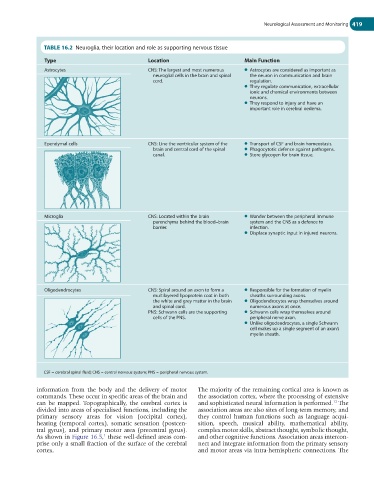
               TABLE 16.2  Neuroglia, their location and role as supporting nervous tissue

                Type                             Location                        Main Function
                Astrocytes                       CNS: The largest and most numerous   ●  Astrocytes are considered as important as
                                                   neuroglial cells in the brain and spinal   the neuron in communication and brain
                                                   cord.                           regulation.
                                                                                 ●  They regulate communication, extracellular
                                                                                   ionic and chemical environments between
                                                                                   neurons.
                                                                                 ●  They respond to injury and have an
                                                                                   important role in cerebral oedema.


                Ependymal cells                  CNS: Line the ventricular system of the   ●  Transport of CSF and brain homeostasis.
                                                   brain and central cord of the spinal   ●  Phagocytotic defence against pathogens.
                                                   canal.                        ●  Store glycogen for brain tissue.


                Microglia                        CNS: Located within the brain   ●  Wander between the peripheral immune
                                                   parenchyma behind the blood–brain   system and the CNS as a defence to
                                                   barrier.                        infection.
                                                                                 ●  Displace synaptic input in injured neurons.


                Oligodendrocytes                 CNS: Spiral around an axon to form a   ●  Responsible for the formation of myelin
                                                   multilayered lipoprotein coat in both   sheaths surrounding axons.
                                                   the white and grey matter in the brain   ●  Oligodendrocytes wrap themselves around
                                                   and spinal cord.                numerous axons at once.
                                                 PNS: Schwann cells are the supporting   ●  Schwann cells wrap themselves around
                                                   cells of the PNS.               peripheral nerve axon.
                                                                                 ●  Unlike oligodendrocytes, a single Schwann
                                                                                   cell makes up a single segment of an axon’s
                                                                                   myelin sheath.


               CSF = cerebral spinal fluid; CNS = central nervous system; PNS = peripheral nervous system.


             information  from  the  body  and  the  delivery  of  motor   The majority of the remaining cortical area is known as
             commands. These occur in specific areas of the brain and   the association cortex, where the processing of extensive
                                                                                                              12
             can  be  mapped.  Topographically,  the  cerebral  cortex  is   and sophisticated neural information is performed.  The
             divided into areas of specialised functions, including the   association areas are also sites of long-term memory, and
             primary  sensory  areas  for  vision  (occipital  cortex),   they  control  human  functions  such  as  language  acqui-
             hearing  (temporal  cortex),  somatic  sensation  (postcen-  sition,  speech,  musical  ability,  mathematical  ability,
             tral  gyrus),  and  primary  motor  area  (precentral  gyrus).   complex motor skills, abstract thought, symbolic thought,
                                   1
             As shown in Figure 16.5,  these well-defined areas com-  and other cognitive functions. Association areas intercon-
             prise only a small fraction of the surface of the cerebral   nect and integrate information from the primary sensory
             cortex.                                              and motor areas via intra-hemispheric connections. The

