


Page 443 - ACCCN's Critical Care Nursing
P. 443
420  P R I N C I P L E S   A N D   P R A C T I C E   O F   C R I T I C A L   C A R E

                                                                                       White
                                               Cerebrum                         Grey   matter
                                                                                matter
                                             Diencephalon                                     Sympathetic chain
                                                                            Ventral
                                                                            root                  Sympathetic
                                               Midbrain
                                                                                                  chain ganglion
                                                 Pons
                                                                                                  Dorsal root
                                              Cerebellum                                          ganglion
                              C1                                           Dorsal
                               2               Medulla                     root
                               3                                                                  Layers of
           Cervical             4                                                                 dura mater
           nerves               5              Spinal cord
                                 6
                                 7
                                 8             Cervical
                                 T1            enlargement
                                  2
                                  3                                                               Vertebra
                                 4
                                5                                          Spinal
                                                                           nerve
                              6
           Thoracic          7
           nerves
                           8
                          9
                         10

                        11
                                               Lumbar
                        12                     enlargement

                        L1
                                               Cauda
           Lumbar         2                    equina
           nerves
                            3
                              4
                               5
                               S1
           Sacral                2
           nerves                3
                                 4
                                 5
           Coccygeal          Coc 1
           nerves
                                                                                      82
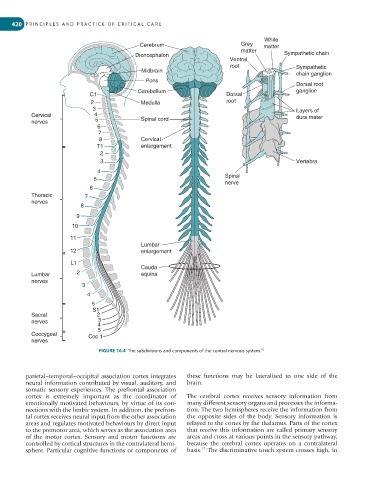
                                 FIGURE 16.4  The subdivisions and components of the central nervous system.


         parietal–temporal–occipital association cortex integrates   these  functions  may  be  lateralised  to  one  side  of  the
         neural information contributed by visual, auditory, and   brain.
         somatic  sensory  experiences.  The  prefrontal  association
         cortex  is  extremely  important  as  the  coordinator  of     The  cerebral  cortex  receives  sensory  information  from
         emotionally motivated behaviours, by virtue of its con-  many different sensory organs and processes the informa-
         nections with the limbic system. In addition, the prefron-  tion. The two hemispheres receive the information from
         tal cortex receives neural input from the other association   the  opposite  sides  of  the  body.  Sensory  information  is
         areas and regulates motivated behaviours by direct input   relayed to the cortex by the thalamus. Parts of the cortex
         to the premotor area, which serves as the association area   that receive this information are called primary sensory
         of  the  motor  cortex.  Sensory  and  motor  functions  are   areas and cross at various points in the sensory pathway,
         controlled by cortical structures in the contralateral hemi-  because  the  cerebral  cortex  operates  on  a  contralateral
                                                                   13
         sphere. Particular cognitive functions or components of   basis.  The discriminative touch system crosses high, in

