


Page 50 - ACCCN's Critical Care Nursing
P. 50
Resourcing Critical Care 27


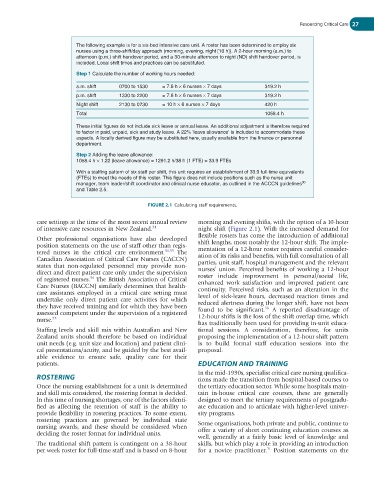
                          The following example is for a six-bed intensive care unit. A roster has been determined to employ six
                          nurses using a three-shift/day approach (morning, evening, night [10 h]). A 2-hour morning (a.m.) to
                          afternoon (p.m.) shift handover period, and a 30-minute afternoon to night (ND) shift handover period, is
                          included. Local shift times and practices can be substituted.
                          Step 1 Calculate the number of working hours needed:

                          a.m. shift    0700 to 1530   = 7.6 h × 6 nurses × 7 days      319.2 h
                          p.m. shift    1330 to 2200   = 7.6 h × 6 nurses × 7 days      319.2 h
                          Night shift   2130 to 0730   = 10 h × 6 nurses × 7 days       420 h
                          Total                                                         1058.4 h

                          These initial figures do not include sick leave or annual leave. An additional adjustment is therefore required
                          to factor in paid, unpaid, sick and study leave. A 22% ‘leave allowance’ is included to accommodate these
                          aspects. A locally derived figure may be substituted here, usually available from the finance or personnel
                          department.
                          Step 2 Adding the leave allowance:
                          1058.4 h × 1.22 (leave allowance) = 1291.2 h/38 h (1 FTE) = 33.9 FTEs
                          With a staffing pattern of six staff per shift, this unit requires an establishment of 33.9 full-time equivalents
                          (FTEs) to meet the needs of this roster. This figure does not include positions such as the nurse unit
                          manager, team leader/shift coordinator and clinical nurse educator, as outlined in the ACCCN guidelines 30
                          and Table 2.5.

                                                 FIGURE 2.1  Calculating staff requirements.

             care settings at the time of the most recent annual review   morning and evening shifts, with the option of a 10-hour
             of intensive care resources in New Zealand. 34       night shift (Figure 2.1). With the increased demand for
                                                                  flexible rosters has come the introduction of additional
             Other  professional  organisations  have  also  developed   shift lengths, most notably the 12-hour shift. The imple-
             position statements on the use of staff other than regis-  mentation of a 12-hour roster requires careful consider-
             tered  nurses  in  the  critical  care  environment. 54,55   The   ation of its risks and benefits, with full consultation of all
             Canadian Association of Critical Care Nurses (CACCN)   parties, unit staff, hospital management and the relevant
             states  that  non-regulated  personnel  may  provide  non-  nurses’  union.  Perceived  benefits  of  working  a  12-hour
             direct and direct patient care only under the supervision   roster  include  improvement  in  personal/social  life,
                              54
             of registered nurses.  The British Association of Critical   enhanced  work  satisfaction  and  improved  patient  care
             Care Nurses (BACCN) similarly determines that health-  continuity.  Perceived  risks,  such  as  an  alteration  in  the
             care  assistants  employed  in  a  critical  care  setting  must   level  of  sick-leave  hours,  decreased  reaction  times  and
             undertake  only  direct  patient  care  activities  for  which   reduced alertness during the longer shift, have not been
             they have received training and for which they have been   found  to  be  significant.   A  reported  disadvantage  of
                                                                                        56
             assessed competent under the supervision of a registered   12-hour shifts is the loss of the shift overlap time, which
             nurse. 55
                                                                  has traditionally been used for providing in-unit educa-
             Staffing levels and skill mix within Australian and New   tional  sessions.  A  consideration,  therefore,  for  units
             Zealand  units  should  therefore  be  based  on  individual   proposing the implementation of a 12-hour shift pattern
             unit needs (e.g. unit size and location) and patient clini-  is  to  build  formal  staff  education  sessions  into  the
             cal presentations/acuity, and be guided by the best avail-  proposal.
             able  evidence  to  ensure  safe,  quality  care  for  their
             patients.                                            EDUCATION AND TRAINING
                                                                  In the mid-1990s, specialist critical care nursing qualifica-
             ROSTERING                                            tions made the transition from hospital-based courses to
             Once the nursing establishment for a unit is determined   the tertiary education sector. While some hospitals main-
             and skill mix considered, the rostering format is decided.   tain  in-house  critical  care  courses,  these  are  generally
             In this time of nursing shortages, one of the factors identi-  designed to meet the tertiary requirements of postgradu-
             fied  as  affecting  the  retention  of  staff  is  the  ability  to   ate education and to articulate with higher-level univer-
             provide flexibility in rostering practices. To some extent,   sity programs.
             rostering  practices  are  governed  by  individual  state
             nursing  awards,  and  these  should  be  considered  when   Some organisations, both private and public, continue to
             deciding the roster format for individual units.     offer a variety of short continuing education courses as
                                                                  well,  generally  at  a  fairly  basic  level  of  knowledge  and
             The traditional shift pattern is contingent on a 38-hour   skills, but which play a role in providing an introduction
                                                                                        31
             per week roster for full-time staff and is based on 8-hour   for  a  novice  practitioner.   Position  statements  on  the

