


Page 453 - ACCCN's Critical Care Nursing
P. 453
430  P R I N C I P L E S   A N D   P R A C T I C E   O F   C R I T I C A L   C A R E


                                                             C-2
                                                                                              C-2
                                                                                              C-3

                                                             C-3                              C-4
                                                       C-4                                    C-5
                                                             T-2                              C-6
                                               C-5           T-3                                             T-2
                                                             T-4                              T-6            T-3
                                                             T-5                              T-7
                                                             T-6                              T-8            C-7
                                                             T-7                              T-9
                                               T-1
                                                             T-8                              T-10
                                                             T-9                              T-11     C-8
                                               C-6           T-10                             T-12           T-1
                                                             T-11
                                                             T-12                                            C-6
                                               C-7                                       L-1       L-1
                                                         L-1  S-3  L-1
                                                                                            S-3  S-3
                                                         L-2      L-2
                                                                                   S-4
                                                  C-8                                    L-2       L-2
                                                          L-3    L-3

                                                                                          S-2     S-2
                                                         L-5      L-5                                  L-4
                                                    L-4                L-4

                                                                                                       L-5


                                                    S-1                S-1
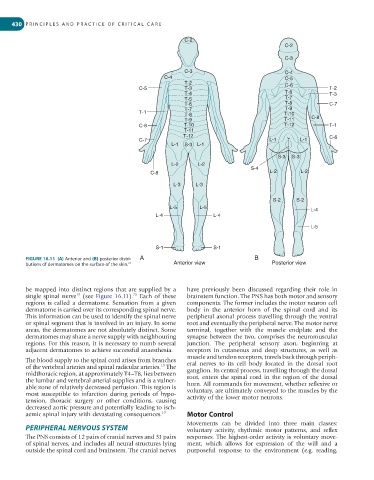
         FIGURE 16.11  (A) Anterior and (B) posterior distri-  A                    B
                                           25
         butions of dermatomes on the surface of the skin.    Anterior view               Posterior view


         be mapped into distinct regions that are supplied by a   have  previously  been  discussed  regarding  their  role  in
                                             25
                          19
         single spinal nerve  (see Figure 16.11).  Each of these   brainstem function. The PNS has both motor and sensory
         regions  is  called  a  dermatome.  Sensation  from  a  given   components. The former includes the motor neuron cell
         dermatome is carried over its corresponding spinal nerve.   body  in  the  anterior  horn  of  the  spinal  cord  and  its
         This information can be used to identify the spinal nerve   peripheral axonal process travelling through the ventral
         or spinal segment that is involved in an injury. In some   root and eventually the peripheral nerve. The motor nerve
         areas, the dermatomes are not absolutely distinct. Some   terminal,  together  with  the  muscle  endplate  and  the
         dermatomes may share a nerve supply with neighbouring   synapse between the two, comprises the neuromuscular
         regions. For this reason, it is necessary to numb several   junction.  The  peripheral  sensory  axon,  beginning  at
         adjacent dermatomes to achieve successful anaesthesia.  receptors  in  cutaneous  and  deep  structures,  as  well  as
                                                              muscle and tendon receptors, travels back through periph-
         The blood supply to the spinal cord arises from branches   eral  nerves  to  its  cell  body  located  in  the  dorsal  root
                                                      19
         of the vertebral arteries and spinal radicular arteries.  The   ganglion. Its central process, travelling through the dorsal
         midthoracic region, at approximately T4–T8, lies between   root, enters the spinal cord in the region of the dorsal
         the lumbar and vertebral arterial supplies and is a vulner-  horn. All commands for movement, whether reflexive or
         able zone of relatively decreased perfusion. This region is   voluntary, are ultimately conveyed to the muscles by the
         most  susceptible  to  infarction  during  periods  of  hypo-  activity of the lower motor neurons.
         tension,  thoracic  surgery  or  other  conditions,  causing
         decreased aortic pressure and potentially leading to isch-
         aemic spinal injury with devastating consequences. 19  Motor Control
                                                              Movements  can  be  divided  into  three  main  classes:
         PERIPHERAL NERVOUS SYSTEM                            voluntary  activity,  rhythmic  motor  patterns,  and  reflex
         The PNS consists of 12 pairs of cranial nerves and 31 pairs   responses. The highest-order activity is voluntary move-
         of spinal nerves, and includes all neural structures lying   ment,  which  allows  for  expression  of  the  will  and  a
         outside the spinal cord and brainstem. The cranial nerves   purposeful  response  to  the  environment  (e.g.  reading,

