


Page 455 - ACCCN's Critical Care Nursing
P. 455
432  P R I N C I P L E S   A N D   P R A C T I C E   O F   C R I T I C A L   C A R E


                 Sympathetic division                                                Parasympathetic division

                                              Dilates pupil  Constricts pupil

                                                                            Oculomotor
                                                             Stimulates     nerve (CN III)
                                                             salivation and
                                             Inhibits        lacrimation
                                             salivation and               Facial nerve (CN VII)
                                             lacrimation
              Cranial                                                   Glossopharangeal          Cranial
                                                                        nerve (CN IX)

                                   Superior                     Constricts            Vagus
                                                                                      nerve
                                   Cervical                     airways               (CN X)
                                   ganglion
                                                Dilates
                                                airways
              Cervical                                                                           Cervical
                                    Inferior
                                    cervical
                                    (stellate)
                                    ganglion    Accelerates
                      T1                        heartbeat      Slows
                      T2                 Stimulates secretion  heartbeat
                      T3                 by sweat
                      T4                 glands       Stimulates glucose
                                                      production
                      T5                              and release
              Thoracic  T6             Fibre-erection                 Liver                      Thoracic
                      T7
                      T8                       Hair     Inhibits  Stimulates
                                               follicle
                                                                  digestion
                      T9                 Coeliac        digestion
                                         ganglion
                     T10
                      T11                                         Stomach
                     T12
                                                             Stimulates gall bladder
                      L1                                     to release bile
                                        Constricts    Gall
                      L2                systemic      bladder
              Lumbar  L3                blood vessels                                             Lumbar
                                                            Pancreas
                                         Superior
                                         mesenteric                 Dilates blood
                                         ganglion                   vessels in
                                   Adrenal                          intestines                 S2
              Sacral                          Constricts                                       S3  Sacral
                                              blood vessels
                                              in intestines                                   S4
                                   Stimulates secretion
                                   of adrenaline and
                                   noradrenaline    Relaxes urinary
                                                    bladder
                                                              Stimulates urinary
                                                              bladder to contract
                                                            Stimulates penile
                                         Inferior           erection
                          Sympathetic    mesenteric
                          trunk          ganglion
                                                   Stimulates                            Key
                                                   ejaculation                              Acetylchloline
                          Paravertebral  Provertebral        Parasympathetic ganglia        Noradrenaline
                            ganglia       ganglia             in or near end organs
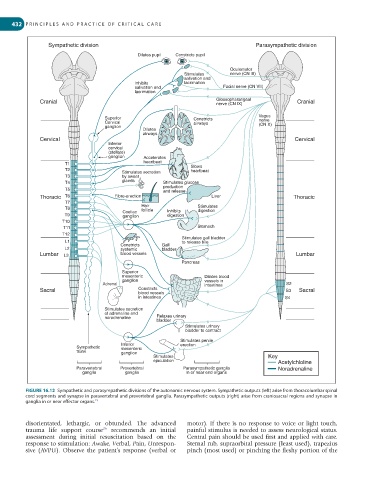
         FIGURE 16.12  Sympathetic and parasympathetic divisions of the autonomic nervous system. Sympathetic outputs (left) arise from thoracolumbar spinal
         cord segments and synapse in paravertebral and prevertebral ganglia. Parasympathetic outputs (right) arise from craniosacral regions and synapse in
                                15
         ganglia in or near effector organs.


         disorientated,  lethargic,  or  obtunded.  The  advanced   motor). If there is no response to voice or light touch,
                                   26
         trauma  life  support  course   recommends  an  initial   painful stimulus is needed to assess neurological status.
         assessment  during  initial  resuscitation  based  on  the   Central pain should be used first and applied with care.
         response to stimulation: Awake, Verbal, Pain, Unrespon-  Sternal rub, supraorbital pressure (least used), trapezius
         sive  (AVPU).  Observe  the  patient’s  response  (verbal  or   pinch (most used) or pinching the fleshy portion of the

