


Page 477 - ACCCN's Critical Care Nursing
P. 477
454  P R I N C I P L E S   A N D   P R A C T I C E   O F   C R I T I C A L   C A R E

                                            50
         significant reduction in ICP for both TBI  and ischaemic   cerebral  vasospasm  occurs  in  approximately  10–15%
               51
         stroke.  In 2011 a multi-centre prospective randomised   of  patients.
         trial of early decompressive craniectomy in patients with
         severe  traumatic  brain  injury  reported  that  in  adults    Calcium antagonists, such as nimodipine, have not been
         with severe diffuse traumatic brain injury and refractory   effective  in  TBI  subarachnoid  haemorrhage  with  vaso-
         intracranial hypertension, early bifrontotemporoparietal   spasm,  and  recent  studies  have  suggested  that  calcium
         decompressive  craniectomy  decreased  intracranial  pres-  antagonists even prevent neurogenesis after TBI. Nimo-
         sure and the length of stay in the ICU but surprisingly   dipine has demonstrated effectiveness in the treatment of
         was associated with more unfavorable outcomes at both   vasospasm in aneurysmal SAH and is now an option for
         6 and 12 months  using the Extended Glasgow Outcome   recommended practice. An initial study of nimodipine in
         Scale. 52                                            patients  with  TBI  demonstrated  no  difference  in  out-
                                                              come, and a Cochrane Systematic Review supports this
         Prevention of Cerebral Vasospasm                     conclusion. 53
         Cerebral  vasospasm  is  a  self-limited  vasculopathy  that   Magnesium  may  prevent  cerebral  vasospasm  through
         develops  4–14  days  after  subarachnoid  haemorrhage   several mechanisms. Increased ATP entry into cells could
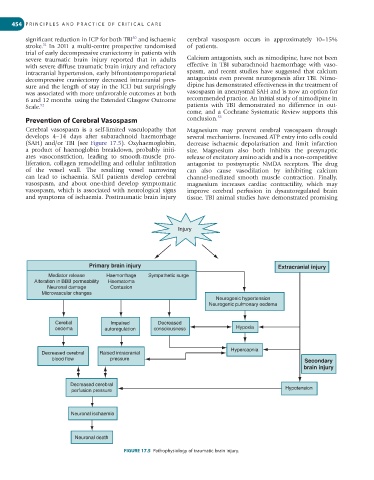
         (SAH)  and/or  TBI  (see  Figure  17.5).  Oxyhaemoglobin,   decrease  ischaemic  depolarisation  and  limit  infarction
         a  product  of  haemoglobin  breakdown,  probably  initi-  size.  Magnesium  also  both  inhibits  the  presynaptic
         ates  vasoconstriction,  leading  to  smooth-muscle  pro-  release of excitatory amino acids and is a non-competitive
         liferation, collagen remodelling and cellular infiltration   antagonist  to  postsynaptic  NMDA  receptors.  The  drug
         of  the  vessel  wall.  The  resulting  vessel  narrowing     can  also  cause  vasodilation  by  inhibiting  calcium
         can  lead  to  ischaemia.  SAH  patients  develop  cerebral   channel-mediated  smooth  muscle  contraction.  Finally,
         va sospasm,  and  about  one-third  develop  symptomatic   magnesium  increases  cardiac  contractility,  which  may
         vasospasm,  which  is  associated  with  neurological  signs   improve  cerebral  perfusion  in  dysautoregulated  brain
         and symptoms of ischaemia. Posttraumatic brain injury   tissue. TBI animal studies have demonstrated promising


                                                           Injury


                              Primary brain injury                                          Extracranial injury
                 Mediator release   Haemorrhage   Sympathetic surge
            Alteration in BBB permeability  Haematoma
                Neuronal damage      Contusion
               Microvascular changes
                                                                        Neurogenic hypertension
                                                                     Neurogenic pulmonary oedema


                   Cerebal           Impaired        Decreased
                   oedema          autoregulation  consciousness              Hypoxia


                                                                             Hypercapnia
               Decreased cerebral  Raised intracranial
                  blood flow         pressure                                                        Secondary
                                                                                                    brain injury


                        Decreased cerebral
                        perfusion pressure                                                    Hypotension


                        Neuronal ischaemia


                          Neuronal death
                                          FIGURE 17.5  Pathophysiology of traumatic brain injury.

