


Page 479 - ACCCN's Critical Care Nursing
P. 479
456  P R I N C I P L E S   A N D   P R A C T I C E   O F   C R I T I C A L   C A R E

                                 Defend CPP            Optimise CPP           Maintain CPP
                                 Restore MAP          Normalise MAP           Maintain MAP
                                  Reduce ICP            Reduce ICP
                      120


                                                                                                 30
                   Cerebral blood flow (mL/100 g/min)  40                             C          10   Intracranial pressure (mmHg)
                                                                                 B
                                          A
                       80

                                                                                                 20


                                 Hypoperfusion         Hyperaemia             Vasospasm
                        0

                           0      1       2      3       4      6       8      10     12     14
                                                      Days post-injury

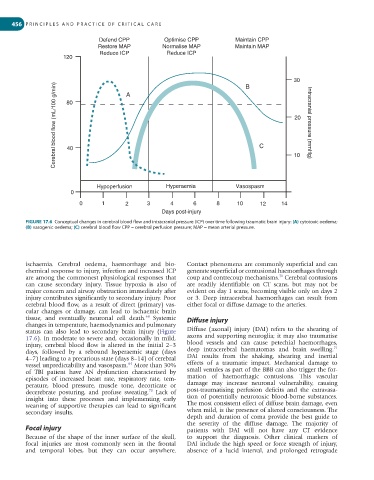
         FIGURE 17.6  Conceptual changes in cerebral blood flow and intracranial pressure (ICP) over time following traumatic brain injury: (A) cytotoxic oedema;
         (B) vasogenic oedema; (C) cerebral blood flow CPP = cerebral perfusion pressure; MAP = mean arterial pressure.


         ischaemia.  Cerebral  oedema,  haemorrhage  and  bio-  Contact phenomena are commonly superficial and can
         chemical response to injury, infection and increased ICP   generate superficial or contusional haemorrhages through
         are among the commonest physiological responses that   coup and contrecoup mechanisms.  Cerebral contusions
                                                                                            71
         can  cause  secondary  injury.  Tissue  hypoxia  is  also  of   are  readily  identifiable  on  CT  scans,  but  may  not  be
         major concern and airway obstruction immediately after   evident on day 1 scans, becoming visible only on days 2
         injury contributes significantly to secondary injury. Poor   or  3.  Deep  intracerebral  haemorrhages  can  result  from
         cerebral blood flow, as a result of direct (primary) vas-  either focal or diffuse damage to the arteries.
         cular  changes  or  damage,  can  lead  to  ischaemic  brain
         tissue,  and  eventually  neuronal  cell  death.   Systemic   Diffuse injury
                                                 68
         changes in temperature, haemodynamics and pulmonary
         status  can  also  lead  to  secondary  brain  injury  (Figure   Diffuse  (axonal)  injury  (DAI)  refers  to  the  shearing  of
         17.6). In moderate to severe and, occasionally in mild,   axons and supporting neuroglia; it may also traumatise
         injury,  cerebral  blood  flow  is  altered  in  the  initial  2–3   blood  vessels  and  can  cause  petechial  haemorrhages,
                                                                                                              71
         days,  followed  by  a  rebound  hyperaemic  stage  (days   deep  intracerebral  haematomas  and  brain  swelling.
         4–7) leading to a precarious state (days 8–14) of cerebral   DAI  results  from  the  shaking,  shearing  and  inertial
         vessel unpredictability and vasospasm.  More than 30%   effects  of  a  traumatic  impact.  Mechanical  damage  to
                                           64
         of  TBI  patient  have  AN  dysfunction  characterised  by    small venules as part of the BBB can also trigger the for-
         episodes  of  increased  heart  rate,  respiratory  rate,  tem-  mation  of  haemorrhagic  contusions.  This  vascular
         perature,  blood  pressure,  muscle  tone,  decorticate  or   damage  may  increase  neuronal  vulnerability,  causing
                                                  70
         decerebrate  posturing,  and  profuse  sweating.   Lack  of   post-traumatising  perfusion  deficits  and  the  extravasa-
         insight  into  these  processes  and  implementing  early   tion  of  potentially  neurotoxic  blood-borne  substances.
         weaning  of  supportive  therapies  can  lead  to  significant   The most consistent effect of diffuse brain damage, even
         secondary insults.                                   when mild, is the presence of altered consciousness. The
                                                              depth  and  duration  of  coma  provide  the  best  guide  to
                                                              the  severity  of  the  diffuse  damage.  The  majority  of
         Focal injury                                         patients  with  DAI  will  not  have  any  CT  evidence
         Because  of  the  shape  of  the  inner  surface  of  the  skull,   to  support  the  diagnosis.  Other  clinical  markers  of
         focal  injuries  are  most  commonly  seen  in  the  frontal    DAI include the high speed or force strength of injury,
         and  temporal  lobes,  but  they  can  occur  anywhere.     absence  of  a  lucid  interval,  and  prolonged  retrograde

