


Page 480 - ACCCN's Critical Care Nursing
P. 480
Neurological Alterations and Management  457

                                                                  in Table 17.2 and is an adaptation of the current guide-
                                                                      32
                                                                  lines   (see  Table  17.3)  to  clinical  practice  (see  Online
                                                                  resources for TBI-related protocols). In all TBI multitrauma
                                                                  patients, disability and exposure/environmental control
                                                                  assessment includes the routine trauma series of X-rays,
                                                                  namely  chest,  pelvis  and  cervical  spine  (lateral,  anter-
                                                                  oposterior  and  odontoid  peg  views).  These  should  be
                                                                  reviewed  by  a  radiologist  and  areas  of  concern,  parti-
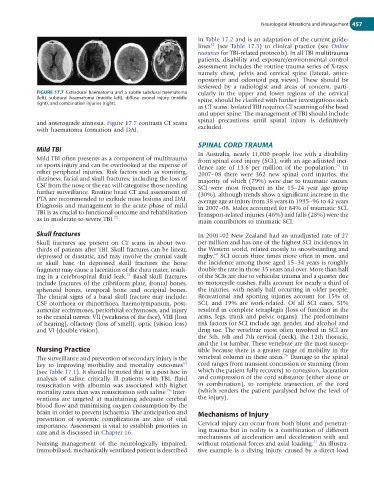
             FIGURE 17.7  Extradural haematoma and a subtle subdural haematoma   cularly  in  the  upper  and  lower  regions  of  the  cervical
             (left),  subdural  haematoma  (middle  left),  diffuse  axonal  injury  (middle   spine, should be clarified with further investigations such
             right), and combination injuries (right).
                                                                  as CT scans. Isolated TBI requires CT scanning of the head
                                                                  and upper spine. The management of TBI should include
             and anterograde amnesia. Figure 17.7 contrasts CT scans   spinal  precautions  until  spinal  injury  is  definitively
             with haematoma formation and DAI.                    excluded.

                                                                  SPINAL CORD TRAUMA
             Mild TBI
                                                                  In Australia, nearly 11,000 people live with a disability
             Mild TBI often presents as a component of multitrauma   from spinal cord injury (SCI), with an age-adjusted inci-
             or sports injury and can be overlooked at the expense of   dence  rate  of  13.6  per  million  of  the  population.   In
                                                                                                               75
             other peripheral injuries. Risk factors such as vomiting,   2007–08  there  were  362  new  spinal  cord  injuries,  the
             dizziness, facial and skull fractures; including the loss of   majority of which (79%) were due to traumatic causes.
             CSF from the nose or the ear, will categorise those needing   SCI  were  most  frequent  in  the  15–24  year  age  group
             further surveillance. Routine head CT and assessment of   (30%), although trends show a significant increase in the
             PTA are recommended to exclude mass lesions and DAI.   average age at injury from 38 years in 1995–96 to 42 years
             Diagnosis and management in the acute phase of mild   in 2007–08. Males accounted for 84% of traumatic SCI.
             TBI is as crucial to functional outcome and rehabilitation   Transport-related injuries (46%) and falls (28%) were the
             as in moderate-to-severe TBI. 72                     main contributors to traumatic SCI.

             Skull fractures                                      In 2001–02 New Zealand had an unadjusted rate of 27
             Skull  fractures  are  present  on  CT  scans  in  about  two-  per million and has one of the highest SCI incidences in
             thirds of patients after TBI. Skull fractures can be linear,   the Western world, related mostly to snowboarding and
                                                                       60
             depressed or diastatic, and may involve the cranial vault   rugby.  SCI occurs three times more often in men, and
             or  skull  base.  In  depressed  skull  fractures  the  bone    the incidence among those aged 15–34 years is roughly
             fragment may cause a laceration of the dura mater, result-  double the rate in those 35 years and over. More than half
             ing  in  a  cerebrospinal  fluid  leak.   Basal  skull  fractures   of the SCIs are due to vehicular trauma and a quarter due
                                          73
             include  fractures  of  the  cribriform  plate,  frontal  bones,   to motorcycle crashes. Falls account for nearly a third of
             sphenoid  bones,  temporal  bone  and  occipital  bones.     the injuries, with nearly half occurring in older people.
             The clinical signs of a basal skull fracture may include:   Recreational  and  sporting  injuries  account  for  15%  of
             CSF otorrhoea or rhinorrhoea, haemotympanum, post-   SCI,  and  19%  are  work-related.  Of  all  SCI  cases,  51%
             auricular ecchymoses, periorbital ecchymoses, and injury   resulted in complete tetraplegia (loss of function in the
             to the cranial nerves: VII (weakness of the face), VIII (loss   arms,  legs,  trunk  and  pelvic  organs).  The  predominant
             of hearing), olfactory (loss of smell), optic (vision loss)   risk factors for SCI include age, gender, and alcohol and
             and VI (double vision).                              drug use. The vertebrae most often involved in SCI are
                                                                  the 5th, 6th and 7th cervical (neck), the 12th thoracic,
                                                                  and the 1st lumbar. These vertebrae are the most suscep-
             Nursing Practice                                     tible because there is a greater range of mobility in the
                                                                                              76
             The surveillance and prevention of secondary injury is the   vertebral column in these areas.  Damage to the spinal
                                                             69
             key  to  improving  morbidity  and  mortality  outcomes    cord ranges from transient concussion or stunning (from
             (see Table 17.1). It should be noted that in a post hoc in   which the patient fully recovers) to contusion, laceration
             analysis  of  saline  critically  ill  patients  with  TBI,  fluid   and compression of the cord substance (either alone or
             resuscitation  with  albumin  was  associated  with  higher   in  combination),  to  complete  transection  of  the  cord
                                                        74
             mortality rates than was resuscitation with saline.  Inter-  (which renders the patient paralysed below the level of
             ventions  are  targeted  at  maintaining  adequate  cerebral   the injury).
             blood flow and minimising oxygen consumption by the
             brain in order to prevent ischaemia. The anticipation and   Mechanisms of Injury
             prevention  of  systemic  complications  are  also  of  vital
             importance. Assessment is vital to establish priorities in   Cervical injury can occur from both blunt and penetrat-
             care and is discussed in Chapter 16.                 ing  trauma  but  in  reality  is  a  combination  of  different
                                                                  mechanisms  of  acceleration  and  deceleration  with  and
                                                                                                       77
             Nursing  management  of  the  neurologically  impaired,   without rotational forces and axial loading.  An illustra-
             immobilised, mechanically ventilated patient is described   tive example is a diving injury, caused by a direct load

