


Page 481 - ACCCN's Critical Care Nursing
P. 481
458  P R I N C I P L E S   A N D   P R A C T I C E   O F   C R I T I C A L   C A R E


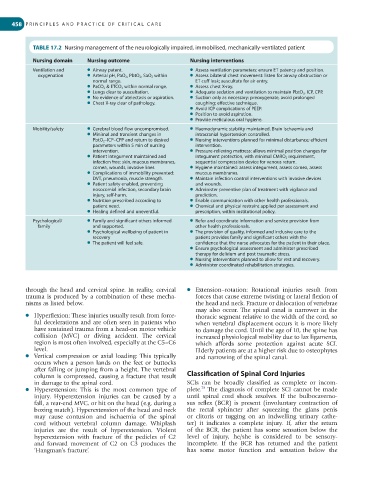
            TABLE 17.2  Nursing management of the neurologically impaired, immobilised, mechanically-ventilated patient

            Nursing domain    Nursing outcome                  Nursing interventions
            Ventilation and   ●  Airway patent.                ●  Assess ventilation parameters: ensure ET patency and position.
             oxygenation      ●  Arterial pH, PaO 2 , PbtO 2 , SaO 2  within   ●  Assess bilateral chest movement: listen for airway obstruction or
                               normal range.                     ET cuff leak; auscultate for air entry.
                              ●  PaCO 2  & ETCO 2  within normal range.  ●  Assess chest X-ray.
                              ●  Lungs clear to auscultation.  ●  Adequate sedation and ventilation to maintain PbtO 2 , ICP, CPP.
                              ●  No evidence of atelectasis or aspiration.  ●  Suction only as necessary: preoxygenate, avoid prolonged
                              ●  Chest X-ray clear of pathology.  coughing; effective technique.
                                                               ●  Avoid ICP complications of PEEP.
                                                               ●  Position to avoid aspiration.
                                                               ●  Provide meticulous oral hygiene.
            Mobility/safety   ●  Cerebral blood flow uncompromised.  ●  Haemodynamic stability maintained. Brain ischaemia and
                              ●  Minimal and transient changes in   intracranial hypertension controlled.
                               PbtO 2 –ICP–CPP and return to desired   ●  Nursing interventions planned for minimal disturbance; efficient
                               parameters within 5 min of nursing   intervention.
                               intervention.                   ●  Pressure-relieving mattress: allows minimal position changes for
                              ●  Patient integument maintained and   integument protection, with minimal CMRO 2  requirement,
                               infection free: skin, mucous membranes,   sequential compression device for venous return.
                               cornea, wounds, invasive lines  ●  Hygiene maintained: assess integument, assess cornea, assess
                              ●  Complications of immobility prevented:   mucous membranes.
                               DVT, pneumonia, muscle strength.  ●  Maintain infection control interventions with invasive devices
                              ●  Patient safety enabled, preventing   and wounds.
                               nosocomial infection, secondary brain   ●  Administer preventive plan of treatment with vigilance and
                               injury, self-harm.                prediction.
                              ●  Nutrition prescribed according to   ●  Enable communication with other health professionals.
                               patient need.                   ●  Chemical and physical restraint applied per assessment and
                              ●  Healing defined and uneventful.  prescription, within institutional policy.
            Psychological/    ●  Family and significant others informed   ●  Refer and coordinate information and service provision from
             family            and supported.                    other health professionals.
                              ●  Psychological wellbeing of patient in   ●  The provision of quality, informed and inclusive care to the
                               recovery                          patient provides family and significant others with the
                              ●  The patient will feel safe.     confidence that the nurse advocates for the patient in their place.
                                                               ●  Ensure psychological assessment and administer prescribed
                                                                 therapy for delirium and post traumatic stress.
                                                               ●  Nursing interventions planned to allow for rest and recovery.
                                                               ●  Administer coordinated rehabilitation strategies.


         through the head and cervical spine. In reality, cervical   ●  Extension–rotation:  Rotational  injuries  result  from
         trauma  is  produced  by  a  combination  of  these  mecha-  forces that cause extreme twisting or lateral flexion of
         nisms as listed below.                                  the head and neck. Fracture or dislocation of vertebrae
                                                                 may  also  occur.  The  spinal  canal  is  narrower  in  the
         ●  Hyperflexion: These injuries usually result from force-  thoracic segment relative to the width of the cord, so
            ful decelerations and are often seen in patients who   when vertebral displacement occurs it is more likely
            have sustained trauma from a head-on motor vehicle   to damage the cord. Until the age of 10, the spine has
            collision  (MVC)  or  diving  accident.  The  cervical   increased physiological mobility due to lax ligaments,
            region is most often involved, especially at the C5–C6   which  affords  some  protection  against  acute  SCI.
            level.                                               Elderly patients are at a higher risk due to osteophytes
         ●  Vertical  compression  or  axial  loading:  This  typically   and narrowing of the spinal canal.
            occurs when a person lands on the feet or buttocks
            after falling or jumping from a height. The vertebral
            column is compressed, causing a fracture that result   Classification of Spinal Cord Injuries
            in damage to the spinal cord.                     SCIs  can  be  broadly  classified  as  complete  or  incom-
                                                                   78
         ●  Hyperextension:  This  is  the  most  common  type  of   plete.  The diagnosis of complete SCI cannot be made
            injury.  Hyperextension  injuries  can  be  caused  by  a   until  spinal  cord  shock  resolves.  If  the  bulbocaverno-
            fall, a rear-end MVC, or hit on the head (e.g. during a   sus  reflex  (BCR)  is  present  (involuntary  contraction  of
            boxing match). Hyperextension of the head and neck   the  rectal  sphincter  after  squeezing  the  glans  penis
            may  cause  contusion  and  ischaemia  of  the  spinal   or  clitoris  or  tugging  on  an  indwelling  urinary  cathe-
            cord  without  vertebral  column  damage.  Whiplash   ter)  it  indicates  a  complete  injury.  If,  after  the  return
            injuries  are  the  result  of  hyperextension.  Violent   of  the  BCR,  the  patient  has  some  sensation  below  the
            hyperextension  with  fracture  of  the  pedicles  of  C2   level  of  injury,  he/she  is  considered  to  be  sensory-
            and  forward  movement  of  C2  on  C3  produces  the   incomplete.  If  the  BCR  has  returned  and  the  patient
            ‘Hangman’s fracture’.                             has  some  motor  function  and  sensation  below  the

