


Page 482 - ACCCN's Critical Care Nursing
P. 482
Neurological Alterations and Management  459


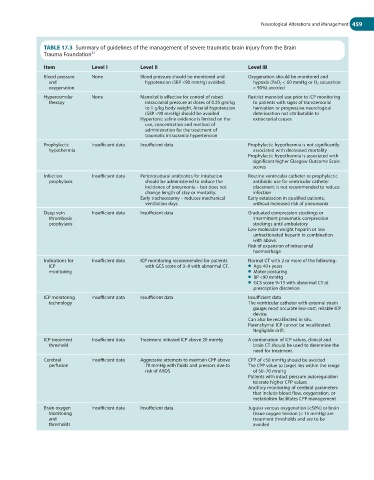
               TABLE 17.3  Summary of guidelines of the management of severe traumatic brain injury from the Brain
               Trauma Foundation 32

               Item            Level I         Level II                           Level III
               Blood pressure   None           Blood pressure should be monitored and   Oxygenation should be monitored and
                 and                             hypotension (SBP <90 mmHg) avoided.  hypoxia (PaO 2  < 60 mmHg or O 2  saturation
                 oxygenation                                                        < 90%) avoided
               Hyperosmolar    None            Mannitol is effective for control of raised   Restrict mannitol use prior to ICP monitoring
                 therapy                         intracranial pressure at doses of 0.25 gm/kg   to patients with signs of transtentorial
                                                 to 1 g/kg body weight. Arterial hypotension   herniation or progressive neurological
                                                 (SBP <90 mmHg) should be avoided   deterioration not attributable to
                                               Hypertonic saline evidence is limited on the   extracranial causes
                                                 use, concentration and method of
                                                 administration for the treatment of
                                                 traumatic intracranial hypertension
               Prophylactic    Insufficient data  Insufficient data               Prophylactic hypothermia is not significantly
                 hypothermia                                                        associated with decreased mortality
                                                                                  Prophylactic hypothermia is associated with
                                                                                    significant higher Glasgow Outcome Scale
                                                                                    scores
               Infection       Insufficient data  Periprocedural antibiotics for intubation   Routine ventricular catheter or prophylactic
                 prophylaxis                     should be administered to reduce the   antibiotic use for ventricular catheter
                                                 incidence of pneumonia – but does not   placement is not recommended to reduce
                                                 change length of stay or mortality.  infection
                                               Early tracheostomy – reduces mechanical   Early extubation in qualified patients,
                                                 ventilation days                   without increased risk of pneumonia
               Deep vein       Insufficient data  Insufficient data               Graduated compression stockings or
                 thrombosis                                                         intermittent pneumatic compression
                 prophylaxis                                                        stockings until ambulatory
                                                                                  Low molecular weight heparin or low
                                                                                    unfractionated heparin in combination
                                                                                    with above.
                                                                                  Risk of expansion of intracranial
                                                                                    haemorrhage
               Indications for   Insufficient data  ICP monitoring recommended for patients   Normal CT with 2 or more of the following:
                 ICP                             with GCS score of 3–8 with abnormal CT.  ●  Age 40+ years
                 monitoring                                                       ●  Motor posturing
                                                                                  ●  BP <90 mmHg
                                                                                  ●  GCS score 9–15 with abnormal CT at
                                                                                    prescription discretion
               ICP monitoring   Insufficient data  Insufficient data              Insufficient data
                 technology                                                       The ventricular catheter with external strain
                                                                                    gauge; most accurate low-cost, reliable ICP
                                                                                    device.
                                                                                  Can also be recalibrated in situ.
                                                                                  Parenchymal ICP cannot be recalibrated.
                                                                                    Negligible drift.
               ICP treatment   Insufficient data  Treatment initiated ICP above 20 mmHg  A combination of ICP values, clinical and
                 threshold                                                          brain CT should be used to determine the
                                                                                    need for treatment.
               Cerebral        Insufficient data  Aggressive attempts to maintain CPP above   CPP of <50 mmHg should be avoided
                 perfusion                       70 mmHg with fluids and pressors due to   The CPP value to target lies within the range
                                                 risk of ARDS                       of 50–70 mmHg
                                                                                  Patients with intact pressure autoregulation
                                                                                    tolerate higher CPP values
                                                                                  Ancillary monitoring of cerebral parameters
                                                                                    that include blood flow, oxygenation, or
                                                                                    metabolism facilitates CPP management
               Brain oxygen    Insufficient data  Insufficient data               Jugular venous oxygenation (<50%) or brain
                 Monitoring                                                         tissue oxygen tension (< 15 mmHg) are
                 and                                                                treatment thresholds and are to be
                 thresholds                                                         avoided

