


Page 511 - ACCCN's Critical Care Nursing
P. 511
488  P R I N C I P L E S   A N D   P R A C T I C E   O F   C R I T I C A L   C A R E

         adequate  circulating  volume  is  assured  by  initial  fluid   RRT  urgent  and  mandatory.  Combined  derangements
         resuscitation) and haemodynamics, encouraging diuresis   can  create  the  necessity  to  commence  therapy  before
         if present, monitoring blood profiles for changes in urea   individually-defined limits have been reached. Early ini-
         and  electrolytes,  and  limiting  or  reformulating  the   tiation of treatment is widely advocated and may confer
         adminis tration of agents that may contribute to the accu-  more rapid renal recovery.
         mulation of urea and electrolytes (e.g. enteral or IV nutri-
         tional supplements). The use of agents such as mannitol,   RENAL DIALYSIS
         dopamine and frusemide, while popular in practice, have
         not been shown to be of any value in improving outcome   Despite its complex physiology, human kidney function
         in patients at risk of ARF. 13,20                    is able to be largely replaced with a management program
                                                              that includes an artificial process of RRT that can sustain
         Despite these efforts, life-threatening biochemistry may   individuals for many years in the community setting. In
         arise in ARF, such as severe acidosis and hyperkalaemia   critically ill patients with ARF, this program focuses pre-
         (a pH of <7.1 and a serum potassium >6.5 mmol/L) that   dominantly on RRT, rather than on the endocrine func-
         requires immediate treatment and can be an indication   tions of the kidney.
         for beginning RRT without elevation of serum creatinine
         and oliguria and fluid overload. 33                  HISTORY
                                                              Dialysis is a term describing RRT and refers to the purifi-
         NUTRITION                                            cation  of  blood  through  a  membrane  by  diffusion  of
                                                                              36
         When  ARF  is  persistent,  providing  nutritional  support     waste  substances.   Table  18.1  outlines  the  historical
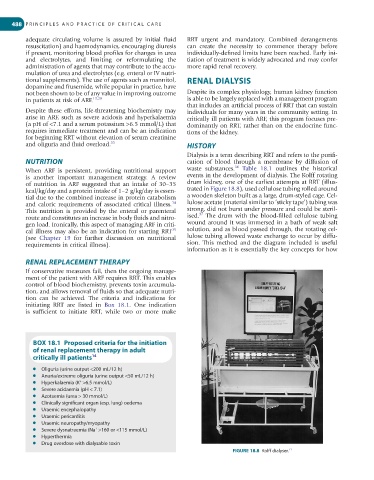
         is  another  important  management  strategy.  A  review     events in the development of dialysis. The Kolff rotating
         of  nutrition  in  ARF  suggested  that  an  intake  of  30–35    drum kidney, one of the earliest attempts at RRT (illus-
         kcal/kg/day and a protein intake of 1–2 g/kg/day is essen-  trated in Figure 18.8), used cellulose tubing rolled around
         tial due to the combined increase in protein catabolism   a wooden skeleton built as a large, drum-styled cage. Cel-
                                                         34
         and  caloric  requirements  of  associated  critical  illness.    lulose acetate (material similar to ‘sticky tape’) tubing was
         This  nutrition  is  provided  by  the  enteral  or  parenteral   strong, did not burst under pressure and could be steril-
                                                                  37
         route and constitutes an increase in body fluids and nitro-  ised.   The  drum  with  the  blood-filled  cellulose  tubing
         gen load. Ironically, this aspect of managing ARF in criti-  wound around it was immersed in a bath of weak salt
                                                         35
         cal illness may also be an indication for starting RRT    solution, and as blood passed through, the rotating cel-
         (see  Chapter  19  for  further  discussion  on  nutritional   lulose tubing allowed waste exchange to occur by diffu-
         requirements in critical illness).                   sion.  This  method  and  the  diagram  included  is  useful
                                                              information as it is essentially the key concepts for how
         RENAL REPLACEMENT THERAPY

         If conservative measures fail, then the ongoing manage-
         ment of the patient with ARF requires RRT. This enables
         control of blood biochemistry, prevents toxin accumula-
         tion, and allows removal of fluids so that adequate nutri-
         tion  can  be  achieved.  The  criteria  and  indications  for
         initiating  RRT  are  listed  in  Box  18.1.  One  indication
         is  sufficient  to  initiate  RRT,  while  two  or  more  make


            BOX 18.1  Proposed criteria for the initiation
            of renal replacement therapy in adult
            critically ill patients 14

            ●  Oliguria (urine output <200 mL/12 h)
            ●  Anuria/extreme oliguria (urine output <50 mL/12 h)
                           +
            ●  Hyperkalaemia (K  >6.5 mmol/L)
            ●  Severe acidaemia (pH < 7.1)
            ●  Azotaemia (urea > 30 mmol/L)
            ●  Clinically significant organ (esp. lung) oedema
            ●  Uraemic encephalopathy
            ●  Uraemic pericarditis
            ●  Uraemic neuropathy/myopathy
                                +
            ●  Severe dysnatraemia (Na  >160 or <115 mmol/L)
            ●  Hyperthermia
            ●  Drug overdose with dialysable toxin
                                                                                                71
                                                                             FIGURE 18.8  Kolff dialyser.

