


Page 52 - ACCCN's Critical Care Nursing
P. 52
Resourcing Critical Care 29

                1.  The provider owed a duty of care to the recipient.  of  strong,  dedicated  and  collaborative  leadership  from
                2.  The provider failed to meet that duty, resulting in   managers  as  the  key  to  organisational  success  in  the
                   a breech of care.                              critical  care  setting.  (See  Chapter  1  for  a  discussion  of
                3.  The recipient sustained damages (loss) as a result.  leadership.)
                4.  The breech by the provider caused the recipient to
                   suffer reasonably foreseeable damages. 68      MANAGING INJURY: STAFF, PATIENT
                                                                  OR VISITOR
             Negligence  is  a  technical  error  that  can  be  proved  in  a
             court, although it does not follow that a negligent person   When staff members are injured, the response must be
             is  incompetent;  in  fact,  many  clinicians  and  managers   swift  and  deliberate.  Injury  can  come  in  many  forms,
             have  probably  been  technically  negligent,  it’s  just  that   involving  physical  injuries  or  biological  exposures,  for
             their errors have yet to be discovered! When managing in   example. More often, the problems are grievances, such
             this context, the best hope is that the frequency of errors   as missing out on an opportunity afforded to others (e.g.
             or negligent actions will be reduced by putting into place   a  promotion),  feeling  marginalised  by  others,  or  not
             systems that prevent such errors from occurring. 66  getting a preferred roster.
             THE ROLE OF LEADERSHIP AND                           For families and patients, an injury can be physical, such
                                                                  as a drug error or an iatrogenic infection; however, the
             MANAGEMENT                                           injury can also be non-physical, as with complaints about
             Managers must also be leaders, and the need to have good   lack of timely information, misinformation or rudeness of
             leaders and managers is as relevant to critical care as it is   staff. In all circumstances a manager needs to intervene
             to  any  other  business  or  clinical  entity.  Research  on   proactively to minimise or contain the negativity or harm
             organisational structures in ICUs across the USA in the   felt by the ‘victim’. Regardless of the cause of the injury, the
             1980s   and  1990s   demonstrated  the  important  role   principles governing good risk management are common
                              70
                  69
             leadership plays in patient care in the ICU. Using APACHE   to many situations and are summarised in Box 2.4.
             scoring,  organisational  efficiency  and  risk-adjusted  sur-
             vival  were  measured.  High-performing  ICUs  demon-  If an incident does occur, it is always prudent to docu-
             strated  that  actual  survival  rates  exceeded  predicted   ment the event as soon as possible afterwards and when
             survival rates.                                      it is safe to do so. The clinician who discovers and follows
                                                                  up  an  incident  must  document  the  event,  asking  the
             Further  investigation  and  analysis  of  the  higher-  questions that a manager, family member, police officer,
             performing units noted that these units had well-defined   lawyer or judge might wish to ask. The written account
             protocols,  a  medical  director  to  coordinate  activities,   provided  soon  after  the  event  or  incident  by  a  person
             well-educated  nurses  and  collaboration  between  nurses   closely  involved  in,  or  witness  to  it,  will  form  a  very
                        69
             and  doctors.   Clear  and  accessible  policies  and  proce-  important  testimonial  in  any  subsequent  investigation
             dures to guide staff practice in the ICU setting were also   (Table 2.6).
                       69
             highlighted.  These need to be in written form, simple   Contemporary wisdom in modern health agencies advo-
             to read and in a consistent format, evidence-based, easy   cates open disclosure: telling the truth to the patient or
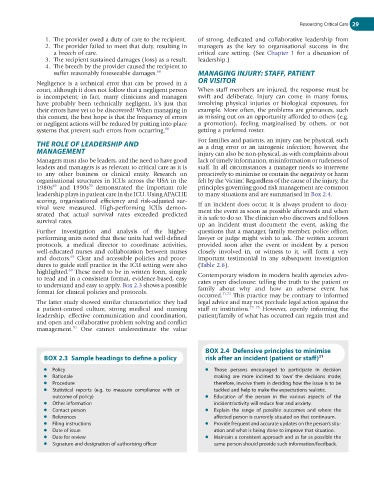
             to understand and easy to apply. Box 2.3 shows a possible   family  about  why  and  how  an  adverse  event  has
             format for clinical policies and protocols.
                                                                  occurred. 71,72  This practice may be contrary to informed
             The latter study showed similar characteristics: they had   legal advice and may not preclude legal action against the
             a  patient-centred  culture,  strong  medical  and  nursing   staff  or  institution. 73–75   However,  openly  informing  the
             leadership,  effective  communication  and  coordination,   patient/family of what has occurred can regain trust and
             and open and collaborative problem solving and conflict
                         70
             management.   One  cannot  underestimate  the  value


                                                                    BOX 2.4  Defensive principles to minimise
               BOX 2.3  Sample headings to define a policy          risk after an incident (patient or staff) 21

               ●  Policy                                            ●  Those  persons  encouraged  to  participate  in  decision
               ●  Rationale                                            making  are  more  inclined  to  ‘own’  the  decisions  made;
               ●  Procedure                                            therefore, involve them in deciding how the issue is to be
               ●  Statistical  reports  (e.g.  to  measure  compliance  with  or   tackled and help to make the expectations realistic.
                  outcome of policy)                                ●  Education  of  the  person  in  the  various  aspects  of  the
               ●  Other information                                    incident/activity will reduce fear and anxiety.
               ●  Contact person                                    ●  Explain  the  range  of  possible  outcomes  and  where  the
               ●  References                                           affected person is currently situated on that continuum.
               ●  Filing instructions                               ●  Provide frequent and accurate updates on the person’s situ-
               ●  Date of issue                                        ation and what is being done to improve that situation.
               ●  Date for review                                   ●  Maintain a consistent approach and as far as possible the
               ●  Signature and designation of authorising officer     same person should provide such information/feedback.

