


Page 54 - ACCCN's Critical Care Nursing
P. 54
Resourcing Critical Care 31


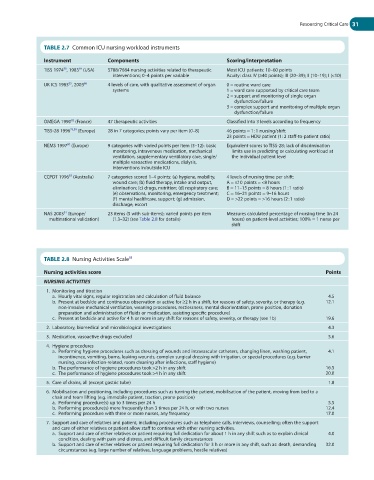
               TABLE 2.7  Common ICU nursing workload instruments

               Instrument           Components                             Scoring/interpretation
                           84
               TISS 1974 , 1983  (USA)  5788/7684 nursing activities related to therapeutic   Most ICU patients: 10–60 points
                      88
                                      interventions; 0–4 points per variable  Acuity: class IV (≥40 points); III (20–39); II (10–19); I (<10)
               UK ICS 1983 , 2003 86  4 levels of care, with qualitative assessment of organ   0 = routine ward care
                       85
                                      systems                              1 = ward care supported by critical care team
                                                                           2 = support and monitoring of single organ
                                                                              dysfunction/failure
                                                                           3 = complex support and monitoring of multiple organ
                                                                              dysfunction/failure
               OMEGA 1990  (France)  47 therapeutic activities             Classified into 3 levels according to frequency
                        82
               TISS-28 1996 79,89  (Europe)  28 in 7 categories; points vary per item (0–8)  46 points = 1 : 1 nursing/shift
                                                                           23 points = HDU patient (1 : 2 staff-to-patient ratio)
                       80
               NEMS 1997  (Europe)  9 categories with varied points per item (3–12): basic   Equivalent scores to TISS-28; lack of discrimination
                                      monitoring, intravenous medication, mechanical   limits use in predicting or calculating workload at
                                      ventilation, supplementary ventilatory care, single/  the individual patient level
                                      multiple vasoactive medications, dialysis,
                                      interventions in/outside ICU
               CCPDT 1996  (Australia)  7 categories scored 1–4 points: (a) hygiene, mobility,   4 levels of nursing time per shift:
                        83
                                      wound care; (b) fluid therapy, intake and output,   A = ≤10 points = <8 hours
                                      elimination; (c) drugs, nutrition; (d) respiratory care;   B = 11–15 points = 8 hours (1 : 1 ratio)
                                      (e) observations, monitoring, emergency treatment;   C = 16–21 points = 9–16 hours
                                      (f) mental healthcare, support; (g) admission,   D = >22 points = >16 hours (2 : 1 ratio)
                                      discharge, escort
               NAS 2003  (Europe/   23 items (5 with sub-items); varied points per item   Measures calculated percentage of nursing time (in 24
                      81
                 multinational validation)  (1.3–32) (see Table 2.8 for details)  hours) on patient-level activities; 100% = 1 nurse per
                                                                             shift


                                           81
               TABLE 2.8  Nursing Activities Scale
               Nursing activities score                                                                     Points
               NURSING ACTIVITIES
                 1.  Monitoring and titration
                  a.  Hourly vital signs, regular registration and calculation of fluid balance             4.5
                  b.  Present at bedside and continuous observation or active for ≥2 h in a shift, for reasons of safety, severity, or therapy (e.g.   12.1
                    non-invasive mechanical ventilation, weaning procedures, restlessness, mental disorientation, prone position, donation
                    preparation and administration of fluids or medication, assisting specific procedure)
                  c.  Present at bedside and active for 4 h or more in any shift for reasons of safety, severity, or therapy (see 1b)  19.6
                 2.  Laboratory, biomedical and microbiological investigations                              4.3
                 3.  Medication, vasoactive drugs excluded                                                  5.6
                 4.  Hygiene procedures
                  a.  Performing hygiene procedures such as dressing of wounds and intravascular catheters, changing linen, washing patient,   4.1
                    incontinence, vomiting, burns, leaking wounds, complex surgical dressing with irrigation, or special procedures (e.g. barrier
                    nursing, cross-infection-related, room cleaning after infections, staff hygiene)
                  b.  The performance of hygiene procedures took >2 h in any shift                          16.5
                  c.  The performance of hygiene procedures took >4 h in any shift                          20.0
                 5.  Care of drains, all (except gastric tube)                                              1.8
                 6.  Mobilisation and positioning, including procedures such as turning the patient, mobilisation of the patient, moving from bed to a
                  chair and team lifting (e.g. immobile patient, traction, prone position)
                  a.  Performing procedure(s) up to 3 times per 24 h                                        5.5
                  b.  Performing procedure(s) more frequently than 3 times per 24 h, or with two nurses     12.4
                  c.  Performing procedure with three or more nurses, any frequency                         17.0
                 7.  Support and care of relatives and patient, including procedures such as telephone calls, interviews, counselling; often the support
                  and care of either relatives or patient allow staff to continue with other nursing activities.
                  a.  Support and care of either relatives or patient requiring full dedication for about 1 h in any shift such as to explain clinical   4.0
                    condition, dealing with pain and distress, and difficult family circumstances
                  b.  Support and care of either relatives or patient requiring full dedication for 3 h or more in any shift, such as: death, demanding   32.0
                    circumstances (e.g. large number of relatives, language problems, hostile relatives)

