


Page 55 - ACCCN's Critical Care Nursing
P. 55
32  S C O P E   O F   C R I T I C A L   C A R E


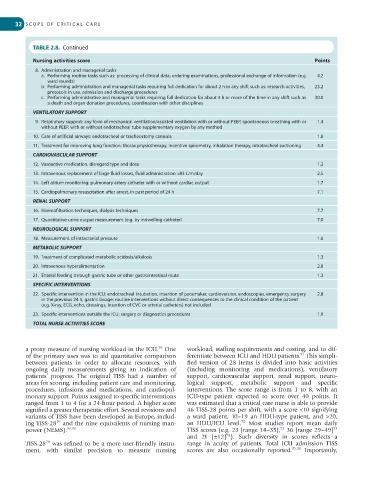
            TABLE 2.8,  Continued

            Nursing activities score                                                                    Points
              8.  Administration and managerial tasks
               a.  Performing routine tasks such as: processing of clinical data, ordering examinations, professional exchange of information (e.g.   4.2
                 ward rounds)
               b.  Performing administration and managerial tasks requiring full dedication for about 2 h in any shift such as: research activities,   23.2
                 protocols in use, admission and discharge procedures
               c.  Performing administrative and managerial tasks requiring full dedication for about 4 h or more of the time in any shift such as   30.0
                 a death and organ donation procedures, coordination with other disciplines
            VENTILATORY SUPPORT
              9.  Respiratory support: any form of mechanical ventilation/assisted ventilation with or without PEEP, spontaneous breathing with or   1.4
               without PEEP, with or without endotracheal tube supplementary oxygen by any method
            10.  Care of artificial airways: endotracheal or tracheostomy cannula                        1.8
            11.  Treatment for improving lung function: thorax physiotherapy, incentive spirometry, inhalation therapy, intratracheal suctioning  4.4
            CARDIOVASCULAR SUPPORT
            12.  Vasoactive medication, disregard type and dose                                          1.2
            13.  Intravenous replacement of large fluid losses, fluid administration >83 L/m/day         2.5
            14.  Left atrium monitoring: pulmonary artery catheter with or without cardiac output        1.7
            15.  Cardiopulmonary resuscitation after arrest, in past period of 24 h                      7.1
            RENAL SUPPORT
            16.  Haemofiltration techniques, dialysis techniques                                         7.7
            17.  Quantitative urine output measurement (e.g. by indwelling catheter)                     7.0
            NEUROLOGICAL SUPPORT
            18.  Measurement of intracranial pressure                                                    1.6
            METABOLIC SUPPORT
            19.  Treatment of complicated metabolic acidosis/alkalosis                                   1.3
            20.  Intravenous hyperalimentation                                                           2.8
            21.  Enteral feeding through gastric tube or other gastrointestinal route                    1.3
            SPECIFIC INTERVENTIONS
            22.  Specific intervention in the ICU: endotracheal intubation, insertion of pacemaker, cardioversion, endoscopies, emergency surgery   2.8
               in the previous 24 h, gastric lavage; routine interventions without direct consequences to the clinical condition of the patient
               (e.g. X-ray, ECG, echo, dressings, insertion of CVC or arterial catheters) not included
            23.  Specific interventions outside the ICU; surgery or diagnostics procedures               1.9
            TOTAL NURSE ACTIVITIES SCORE


                                                     89
         a proxy measure of nursing workload in the ICU.  One   workload, staffing requirements and costing, and to dif-
                                                                                                   91
         of the primary uses was to aid quantitative comparison   ferentiate between ICU and HDU patients.  This simpli-
         between  patients  in  order  to  allocate  resources,  with   fied  version  of  28  items  is  divided  into  basic  activities
         ongoing  daily  measurements  giving  an  indication  of   (including  monitoring  and  medications),  ventilatory
         patients’  progress.  The  original  TISS  had  a  number  of   support,  cardio vascular  support,  renal  support,  neuro-
         areas for scoring, including patient care and monitoring,   logical  support,  metabolic  support  and  specific
         procedures,  infusions  and  medications,  and  cardiopul-  in terventions.  The  score  range  is  from  1  to  8,  with  an
         monary support. Points assigned to specific interventions   ICU-type  patient  expected  to  score  over  40  points.  It
         ranged from 1 to 4 for a 24-hour period. A higher score   was estimated that a critical care nurse is able to provide
         signified a greater therapeutic effort. Several revisions and   46 TISS-28 points per shift, with a score <10 signifying
         variants of TISS have been developed in Europe, includ-  a  ward  patient,  10–19  an  HDU-type  patient,  and  >20,
                   79
                                                                                79
         ing TISS-28  and the nine equivalents of nursing man-  an  HDU/ICU  level.   Most  studies  report  mean  daily
                                                                                             92
                                                                                                              93
         power (NEMS). 80,90                                  TISS scores (e.g. 23 [range 14–35],  36 [range 29–49]
                                                                           94
                                                              and  21  [±12] ).  Such  diversity  in  scores  reflects  a
                79
         TISS-28  was refined to be a more user-friendly instru-  range  in  acuity  of  patients.  Total  ICU  admission  TISS
         ment,  with  similar  precision  to  measure  nursing    scores  are  also  occasionally  reported. 95,96   Importantly,

