


Page 53 - ACCCN's Critical Care Nursing
P. 53
30  S C O P E   O F   C R I T I C A L   C A R E


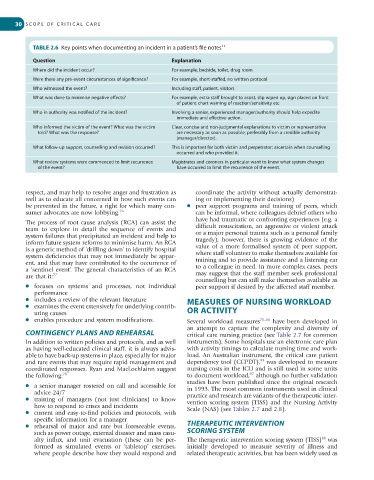
            TABLE 2.6  Key points when documenting an incident in a patient’s file notes 21

            Question                                     Explanation
            Where did the incident occur?                For example, bedside, toilet, drug room
            Were there any pre-event circumstances of significance?  For example, short-staffed, no written protocol
            Who witnessed the event?                     Including staff, patient, visitors
            What was done to minimise negative effects?  For example, extra staff brought to assist, slip wiped up, sign placed on front
                                                           of patient chart warning of reaction/sensitivity etc
            Who in authority was notified of the incident?  Involving a senior, experienced manager/authority should help expedite
                                                           immediate and effective action.
            Who informed the victim of the event? What was the victim   Clear, concise and non-judgmental explanations to victim or representative
             told? What was the response?                  are necessary as soon as possible, preferably from a credible authority
                                                           (manager/director).
            What follow-up support, counselling and revision occurred?  This is important for both victim and perpetrator; ascertain when counselling
                                                           occurred and who provided it.
            What review systems were commenced to limit recurrence   Magistrates and coroners in particular want to know what system changes
             of the event?                                 have occurred to limit the recurrence of the event.


         respect, and may help to resolve anger and frustration as   coordinate  the  activity  without  actually  demonstrat-
         well as to educate all concerned in how such events can   ing or implementing their decisions)
         be prevented in the future, a right for which many con-  ●  peer support programs and training of peers, which
         sumer advocates are now lobbying. 76                    can be informal, where colleagues debrief others who
                                                                 have had traumatic or confronting experiences (e.g. a
         The process of root cause analysis (RCA) can assist the
         team  to  explore  in  detail  the  sequence  of  events  and   difficult resuscitation, an aggressive or violent attack
         system failures that precipitated an incident and help to   or a major personal trauma such as a personal family
         inform future system reforms to minimise harm. An RCA   tragedy);  however,  there  is  growing  evidence  of  the
         is a generic method of ‘drilling down’ to identify hospital   value  of  a  more  formalised  system  of  peer  support,
         system deficiencies that may not immediately be appar-  where staff volunteer to make themselves available for
         ent, and that may have contributed to the occurrence of   training and to provide assistance and a listening ear
         a ‘sentinel event’. The general characteristics of an RCA   to a colleague in need. In more complex cases, peers
         are that it: 77                                         may suggest that the staff member seek professional
                                                                 counselling but can still make themselves available as
         ●  focuses  on  systems  and  processes,  not  individual   peer support if desired by the affected staff member.
            performance
         ●  includes a review of the relevant literature      MEASURES OF NURSING WORKLOAD
         ●  examines the event extensively for underlying contrib-
            uting causes                                      OR ACTIVITY
         ●  enables procedure and system modifications.       Several workload measures 79–86  have been developed in
                                                              an  attempt  to  capture  the  complexity  and  diversity  of
         CONTINGENCY PLANS AND REHEARSAL                      critical care nursing practice (see Table 2.7 for common
         In addition to written policies and protocols, and as well   instruments). Some hospitals use an electronic care plan
         as having well-educated clinical staff, it is always advis-  with activity timings to calculate nursing time and work-
         able to have back-up systems in place, especially for major   load. An Australian instrument, the critical care patient
                                                                                      83
         and rare events that may require rapid management and   dependency tool (CCPDT),  was developed to measure
         coordinated responses. Ryan and MacLochlainn suggest   nursing costs in the ICU and is still used in some units
                                                                                   87
         the following: 78                                    to document workload,  although no further validation
                                                              studies have been published since the original research
         ●  a senior manager rostered on call and accessible for   in 1993. The most common instruments used in clinical
            advice 24/7                                       practice and research are variants of the therapeutic inter-
         ●  training  of  managers  (not  just  clinicians)  to  know   vention  scoring  system  (TISS)  and  the  Nursing  Activity
            how to respond to crises and incidents            Scale (NAS) (see Tables 2.7 and 2.8).
         ●  current and easy-to-find policies and protocols, with
            specific information for a manager
         ●  rehearsal  of  major  and  rare  but  foreseeable  events,   THERAPEUTIC INTERVENTION
            such as power outage, external disaster and mass casu-  SCORING SYSTEM
                                                                                                          88
            alty  influx,  and  unit  evacuation  (these  can  be  per-  The therapeutic intervention scoring system (TISS)  was
            formed  as  simulated  events  or  ‘tabletop’  exercises,   initially  developed  to  measure  severity  of  illness  and
            where people describe how they would respond and   related therapeutic activities, but has been widely used as

