


Page 543 - ACCCN's Critical Care Nursing
P. 543
520  P R I N C I P L E S   A N D   P R A C T I C E   O F   C R I T I C A L   C A R E


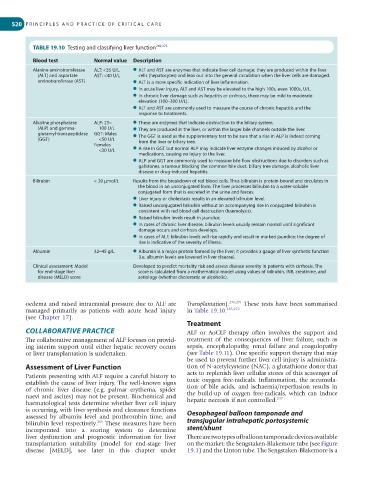
            TABLE 19.10  Testing and classifying liver function 269,273

            Blood test          Normal value  Description
            Alanine aminotransferase   ALT: <35 U/L  ●  ALT and AST are enzymes that indicate liver cell damage; they are produced within the liver
             (ALT) and aspartate   AST: <40 U/L  cells (hepatocytes) and leak out into the general circulation when the liver cells are damaged.
             aminotransferase (AST)          ●  ALT is a more specific indication of liver inflammation.
                                             ●  In acute liver injury, ALT and AST may be elevated to the high 100s, even 1000s, U/L.
                                             ●  In chronic liver damage such as hepatitis or cirrhosis, there may be mild to moderate
                                              elevation (100–300 U/L).
                                             ●  ALT and AST are commonly used to measure the course of chronic hepatitis and the
                                              response to treatments.
            Alkaline phosphatase   ALP: 25–  ●  These are enzymes that indicate obstruction to the biliary system.
             (ALP) and gamma-    100 U/L     ●  They are produced in the liver, or within the larger bile channels outside the liver.
             glutamyl-transpeptidase   GGT: Males   ●  The GGT is used as the supplementary test to be sure that a rise in ALP is indeed coming
             (GGT)               <50 U/L      from the liver or biliary tree.
                                Females
                                 <30 U/L     ●  A rise in GGT but normal ALP may indicate liver enzyme changes induced by alcohol or
                                              medications, causing no injury to the liver.
                                             ●  ALP and GGT are commonly used to measure bile flow obstructions due to disorders such as
                                              gallstones, a tumour blocking the common bile duct, biliary tree damage, alcoholic liver
                                              disease or drug-induced hepatitis.
            Bilirubin           < 20 µmol/L  Results from the breakdown of red blood cells. Thus bilirubin is protein-bound and circulates in
                                              the blood in an unconjugated form. The liver processes bilirubin to a water-soluble
                                              conjugated form that is excreted in the urine and faeces.
                                             ●  Liver injury or cholestasis results in an elevated bilirubin level.
                                             ●  Raised unconjugated bilirubin without an accompanying rise in conjugated bilirubin is
                                              consistent with red blood cell destruction (haemolysis).
                                             ●  Raised bilirubin levels result in jaundice.
                                             ●  In cases of chronic liver disease, bilirubin levels usually remain normal until significant
                                              damage occurs and cirrhosis develops.
                                             ●  In cases of ALF, bilirubin levels will rise rapidly and result in marked jaundice; the degree of
                                              rise is indicative of the severity of illness.
            Albumin             32–45 g/L    ●  Albumin is a major protein formed by the liver; it provides a gauge of liver synthetic function
                                              (i.e. albumin levels are lowered in liver disease).
            Clinical assessment: Model       Developed to predict mortality risk and assess disease severity in patients with cirrhosis. The
             for end-stage liver              score is calculated from a mathematical model using values of bilirubin, INR, creatinine, and
             disease (MELD) score             aetiology (whether cholestatic or alcoholic).


         oedema and raised intracranial pressure due to ALF are   Transplantation). 270,271  These tests have been summarised
         managed  primarily  as  patients  with  acute  head  injury   in Table 19.10. 253,272
         (see Chapter  17).
                                                              Treatment
         COLLABORATIVE PRACTICE                               ALF  or  AoCLF  therapy  often  involves  the  support  and

         The collaborative management of ALF focuses on provid-  treatment  of  the  consequences  of  liver  failure,  such  as
         ing interim support until either hepatic recovery occurs   sepsis,  encephalopathy,  renal  failure  and  coagulopathy
         or liver transplantation is undertaken.              (see Table 19.11). One specific support therapy that may
                                                              be used to prevent further liver cell injury is administra-
         Assessment of Liver Function                         tion of N-acetylcysteine (NAC), a glutathione donor that
         Patients presenting with ALF require a careful history to   acts to replenish liver cellular stores of this scavenger of
         establish the cause of liver injury. The well-known signs   toxic oxygen free-radicals. Inflammation, the accumula-
         of  chronic  liver  disease  (e.g.  palmar  erythema,  spider   tion  of  bile  acids,  and  ischaemia/reperfusion  results  in
         naevi and ascites) may not be present. Biochemical and   the  build-up  of  oxygen  free-radicals,  which  can  induce
                                                                                            237
         haematological tests determine whether liver cell injury   hepatic necrosis if not controlled.
         is occurring, with liver synthesis and clearance functions   Oesophageal balloon tamponade and
         assessed  by  albumin  level  and  prothrombin  time,  and
         bilirubin level respectively. 269  These measures have been   transjugular intrahepatic portosystemic
         incorporated  into  a  scoring  system  to  determine    stent/shunt
         liver  dysfunction  and  prognostic  information  for  liver   There are two types of balloon tamponade devices available
         transplantation  suitability  (model  for  end-stage  liver    on the market: the Sengstaken-Blakemore tube (see Figure
         disease  [MELD],  see  later  in  this  chapter  under   19.1) and the Linton tube. The Sengstaken-Blakemore is a

