


Page 62 - ACCCN's Critical Care Nursing
P. 62
Quality and Safety 39


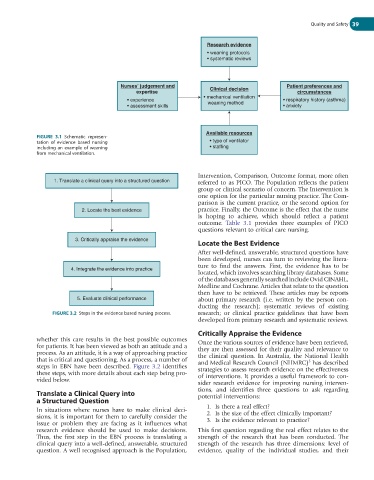
                                                                     Research evidence
                                                                     • weaning protocols
                                                                     • systematic reviews


                                         Nurses’ judgement and        Clinical decision        Patient preferences and
                                              expertise                                           circumstances
                                           • experience             • mechanical ventilation  • respiratory history (asthma)
                                                                       weaning method
                                           • assessment skills                                • anxiety


                                                                    Available resources
             FIGURE  3.1  Schematic  represen-
             tation  of  evidence  based  nursing                     • type of ventilator
             including  an  example  of  weaning                      • staffing
             from mechanical ventilation.


                                                                  Intervention, Comparison, Outcome format, more often
                   1. Translate a clinical query into a structured question  referred to as PICO. The Population reflects the patient
                                                                  group or clinical scenario of concern. The Intervention is
                                                                  one option for the particular nursing practice. The Com-
                                                                  parison is the current practice, or the second option for
                            2. Locate the best evidence           practice. Finally, the Outcome is the effect that the nurse
                                                                  is  hoping  to  achieve,  which  should  reflect  a  patient
                                                                  outcome.  Table  3.1  provides  three  examples  of  PICO
                                                                  questions relevant to critical care nursing.
                          3. Critically appraise the evidence
                                                                  Locate the Best Evidence
                                                                  After well-defined, answerable, structured questions have
                                                                  been developed, nurses can turn to reviewing the litera-
                                                                  ture  to  find  the  answers.  First,  the  evidence  has  to  be
                        4. Integrate the evidence into practice
                                                                  located, which involves searching library databases. Some
                                                                  of the databases generally searched include Ovid CINAHL,
                                                                  Medline and Cochrane. Articles that relate to the question
                                                                  then have to be retrieved. These articles may be reports
                          5. Evaluate clinical performance        about primary research (i.e. written by the person con-
                                                                  ducting  the  research);  systematic  reviews  of  existing
                  FIGURE 3.2  Steps in the evidence based nursing process.   research;  or  clinical  practice  guidelines  that  have  been
                                                                  developed from primary research and systematic reviews.

                                                                  Critically Appraise the Evidence
             whether this care results in the best possible outcomes   Once the various sources of evidence have been retrieved,
             for patients. It has been viewed as both an attitude and a   they are then assessed for their quality and relevance to
             process. As an attitude, it is a way of approaching practice   the  clinical  question.  In  Australia,  the  National  Health
             that is critical and questioning. As a process, a number of   and Medical Research Council (NHMRC)  has described
                                                                                                      5
             steps in EBN have been described. Figure 3.2 identifies   strategies to assess research evidence on the effectiveness
             these steps, with more details about each step being pro-  of interventions. It provides a useful framework to con-
             vided below.
                                                                  sider research evidence for improving nursing interven-
             Translate a Clinical Query into                      tions,  and  identifies  three  questions  to  ask  regarding
                                                                  potential interventions:
             a Structured Question
             In  situations  where  nurses  have  to  make  clinical  deci-  1.  Is there a real effect?
                                                                     2.  Is the size of the effect clinically important?
             sions, it is important for them to carefully consider the   3.  Is the evidence relevant to practice?
             issue  or  problem  they  are  facing  as  it  influences  what
             research  evidence  should  be  used  to  make  decisions.   This first question regarding the real effect relates to the
             Thus,  the  first  step  in  the  EBN  process  is  translating  a   strength  of  the  research  that  has  been  conducted.  The
             clinical query into a well-defined, answerable, structured   strength  of  the  research  has  three  dimensions:  level  of
             question. A well recognised approach is the Population,   evidence,  quality  of  the  individual  studies,  and  their

