


Page 63 - ACCCN's Critical Care Nursing
P. 63
40  S C O P E   O F   C R I T I C A L   C A R E


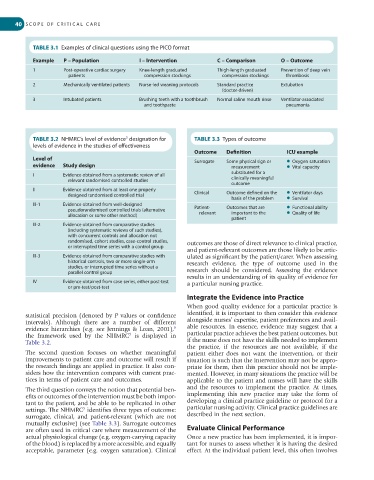
            TABLE 3.1  Examples of clinical questions using the PICO format

            Example   P – Population           I – Intervention         C – Comparison       O – Outcome
            1         Post-operative cardiac surgery   Knee-length graduated   Thigh-length graduated   Prevention of deep vein
                       patients                 compression stockings     compression stockings  thrombosis
            2         Mechanically ventilated patients  Nurse-led weaning protocols  Standard practice   Extubation
                                                                          (doctor-driven)
            3         Intubated patients       Brushing teeth with a toothbrush   Normal saline mouth rinse  Ventilator-associated
                                                and toothpaste                                 pneumonia


            TABLE 3.2  NHMRC’s level of evidence  designation for   TABLE 3.3  Types of outcome
                                          5
            levels of evidence in the studies of effectiveness
                                                                 Outcome   Definition          ICU example
            Level of                                             Surrogate  Some physical sign or   ●  Oxygen saturation
            evidence  Study design                                           measurement       ●  Vital capacity
            I         Evidence obtained from a systematic review of all      substituted for a
                       relevant randomised controlled studies                clinically meaningful
                                                                             outcome
            II        Evidence obtained from at least one properly
                       designed randomised controlled trial      Clinical  Outcome defined on the   ●  Ventilator days
                                                                             basis of the problem  ●  Survival
            III-1     Evidence obtained from well-designed
                       pseudorandomised controlled trials (alternative   Patient-  Outcomes that are   ●  Functional ability
                       allocation or some other method)           relevant   important to the   ●  Quality of life
                                                                             patient
            III-2     Evidence obtained from comparative studies
                       (including systematic reviews of such studies),
                       with concurrent controls and allocation not
                       randomised, cohort studies, case-control studies,   outcomes are those of direct relevance to clinical practice,
                       or interrupted time series with a control group
                                                              and patient-relevant outcomes are those likely to be artic-
            III-3     Evidence obtained from comparative studies with   ulated as significant by the patient/carer. When assessing
                       historical controls, two or more single-arm   research  evidence,  the  type  of  outcome  used  in  the
                       studies, or interrupted time series without a
                       parallel control group                 research  should  be  considered.  Assessing  the  evidence
                                                              results in an understanding of its quality of evidence for
            IV        Evidence obtained from case series, either post-test   a particular nursing practice.
                       or pre-test/post-test
                                                              Integrate the Evidence into Practice
                                                              When good quality evidence for a particular practice is
         statistical precision (denoted by P values or confidence   identified, it is important to then consider this evidence
         intervals).  Although  there  are  a  number  of  different     alongside nurses’ expertise, patient preferences and avail-
                                                          6
         evidence  hierarchies  (e.g.  see  Jennings  &  Loan,  2001),    able  resources.  In  essence,  evidence  may  suggest  that  a
                                           5
         the  framework  used  by  the  NHMRC   is  displayed  in   particular practice achieves the best patient outcomes, but
         Table 3.2.                                           if the nurse does not have the skills needed to implement
                                                              the  practice,  if  the  resources  are  not  available,  if  the
         The  second  question  focuses  on  whether  meaningful   patient  either  does  not  want  the  intervention,  or  their
         improvements to patient care and outcome will result if   situation is such that the intervention may not be appro-
         the research findings are applied in practice. It also con-  priate for them, then this practice should not be imple-
         siders how the intervention compares with current prac-  mented. However, in many situations the practice will be
         tices in terms of patient care and outcomes.         applicable to the patient and nurses will have the skills
         The third question conveys the notion that potential ben-  and  the  resources  to  implement  the  practice.  At  times,
         efits or outcomes of the intervention must be both impor-  implementing  this  new  practice  may  take  the  form  of
         tant to the patient, and be able to be replicated in other   developing a clinical practice guideline or protocol for a
                            5
         settings. The NHMRC  identifies three types of outcome:   particular nursing activity. Clinical practice guidelines are
         surrogate,  clinical,  and  patient-relevant  (which  are  not   described in the next section.
         mutually exclusive) (see Table 3.3). Surrogate outcomes
         are often used in critical care where measurement of the   Evaluate Clinical Performance
         actual physiological change (e.g. oxygen-carrying capacity   Once a new practice has been implemented, it is impor-
         of the blood) is replaced by a more accessible, and equally   tant for nurses to assess whether it is having the desired
         acceptable,  parameter  (e.g.  oxygen  saturation).  Clinical   effect. At the individual patient level, this often involves

