


Page 67 - ACCCN's Critical Care Nursing
P. 67
44  S C O P E   O F   C R I T I C A L   C A R E


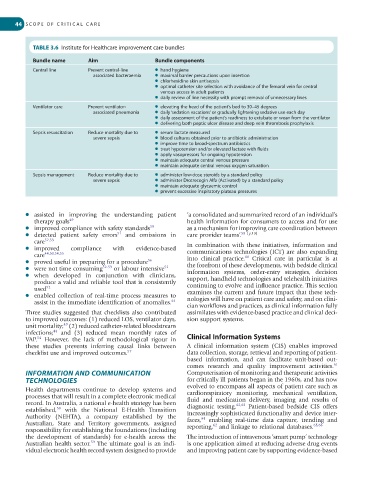
            TABLE 3.6  Institute for Healthcare improvement care bundles

            Bundle name       Aim                   Bundle components
            Central line      Prevent central-line   ●  hand hygiene
                               associated bacteraemia  ●  maximal barrier precautions upon insertion
                                                    ●  chlorhexidine skin antisepsis
                                                    ●  optimal catheter site selection with avoidance of the femoral vein for central
                                                      venous access in adult patients
                                                    ●  daily review of line necessity with prompt removal of unnecessary lines
            Ventilator care   Prevent ventilator-   ●  elevating the head of the patient’s bed to 30–45 degrees
                               associated pneumonia  ●  daily ‘sedation vacations’ or gradually lightening sedative use each day
                                                    ●  daily assessment of the patient’s readiness to extubate or wean from the ventilator
                                                    ●  delivering both peptic ulcer disease and deep vein thrombosis prophylaxis
            Sepsis resuscitation  Reduce mortality due to   ●  serum lactate measured
                               severe sepsis        ●  blood cultures obtained prior to antibiotic administration
                                                    ●  improve time to broad-spectrum antibiotics
                                                    ●  treat hypotension and/or elevated lactate with fluids
                                                    ●  apply vasopressors for ongoing hypotension
                                                    ●  maintain adequate central venous pressure
                                                    ●  maintain adequate central venous oxygen saturation
            Sepsis management  Reduce mortality due to   ●  administer low-dose steroids by a standard policy
                               severe sepsis        ●  administer Drotrecogin Alfa (Activated) by a standard policy
                                                    ●  maintain adequate glycaemic control
                                                    ●  prevent excessive inspiratory plateau pressures


         ●  assisted  in  improving  the  understanding  patient   ‘a consolidated and summarized record of an individual’s
            therapy goals 49                                  health information for consumers to access and for use
         ●  improved compliance with safety standards 50      as a mechanism for improving care coordination between
         ●  detected  patient  safety  errors   and  omissions  in   care provider teams’.
                                                                                58 (p.13)
                                       51
            care 52,53
         ●  improved    compliance    with   evidence-based   In  combination  with  these  initiatives,  information  and
            care 44,50,54,55                                  communications technologies (ICT) are also expanding
                                                                                 60
         ●  proved useful in preparing for a procedure 56     into  clinical  practice.   Critical  care  in  particular  is  at
         ●  were not time consuming 52-53  or labour intensive 52  the forefront of these developments, with bedside clinical
         ●  when  developed  in  conjunction  with  clinicians,   information  systems,  order-entry  strategies,  decision
            produce a valid and reliable tool that is consistently   support, handheld technologies and telehealth initiatives
            used 52                                           continuing to evolve and influence practice. This section
         ●  enabled  collection  of  real-time  process  measures  to   examines the current and future impact that these tech-
            assist in the immediate identification of anomalies. 44  nologies will have on patient care and safety, and on clini-
                                                              cian workflows and practices, as clinical information fully
         Three studies  suggested that  checklists also contributed   assimilates with evidence-based practice and clinical deci-
         to improved outcomes: (1) reduced LOS, ventilator days,   sion support systems.
                      49
         unit mortality;  (2) reduced catheter-related bloodstream
                  44
         infections;   and  (3)  reduced  mean  monthly  rates  of
             54
         VAP.   However,  the  lack  of  methodological  rigour  in   Clinical Information Systems
         these  studies  prevents  inferring  causal  links  between   A  clinical  information  system  (CIS)  enables  improved
         checklist use and improved outcomes. 57              data collection, storage, retrieval and reporting of patient-
                                                              based  information,  and  can  facilitate  unit-based  out-
                                                              comes  research  and  quality  improvement  activities.
                                                                                                              61
         INFORMATION AND COMMUNICATION                        Computerisation of monitoring and therapeutic activities
         TECHNOLOGIES                                         for critically ill patients began in the 1960s, and has now
         Health  departments  continue  to  develop  systems  and   evolved to encompass all aspects of patient care such as
                                                              cardiorespiratory  monitoring,  mechanical  ventilation,
         processes that will result in a complete electronic medical   fluid  and  medication  delivery,  imaging  and  results  of
         record. In Australia, a national e-health strategy has been   diagnostic  testing. 62,63   Patient-based  bedside  CIS  offers
                    58
         established,   with  the  National  E-Health  Transition   increasingly sophisticated functionality and device inter-
         Authority  (NEHTA),  a  company  established  by  the     faces,   enabling  real-time  data  capture,  trending  and
                                                                   64
         Australian,  State  and  Territory  governments,  assigned   reporting,  and linkage to relational databases. 65,66
                                                                       62
         responsibility for establishing the foundations (including
         the  development  of  standards)  for  e-health  across  the   The introduction of intravenous ‘smart pump’ technology
                               59
         Australian health sector.  The ultimate goal is an indi-  is one application aimed at reducing adverse drug events
         vidual electronic health record system designed to provide   and improving patient care by supporting evidence-based

