


Page 64 - ACCCN's Critical Care Nursing
P. 64
Quality and Safety 41


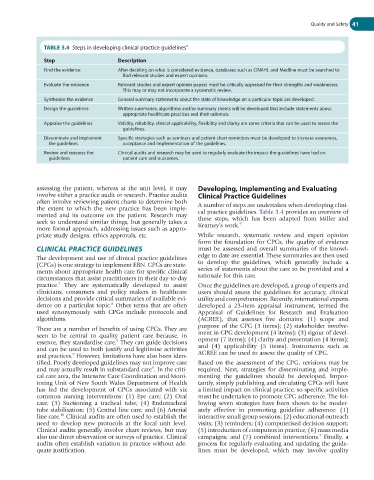
               TABLE 3.4  Steps in developing clinical practice guidelines 9

               Step                     Description
               Find the evidence        After deciding on what is considered evidence, databases such as CINAHL and Medline must be searched to
                                         find relevant studies and expert opinions.
               Evaluate the evidence    Relevant studies and expert opinion papers must be critically appraised for their strengths and weaknesses.
                                         This may or may not incorporate a systematic review.
               Synthesise the evidence  General summary statements about the state of knowledge on a particular topic are developed.
               Design the guidelines    Written summaries, algorithms and/or summary sheets will be developed that include statements about
                                         appropriate healthcare practices and their rationale.
               Appraise the guidelines  Validity, reliability, clinical applicability, flexibility and clarity are some criteria that can be used to assess the
                                         guidelines.
               Disseminate and implement   Specific strategies such as seminars and patient chart reminders must be developed to increase awareness,
                 the guidelines          acceptance and implementation of the guidelines.
               Review and reassess the   Clinical audits and research may be used to regularly evaluate the impact the guidelines have had on
                 guidelines              patient care and outcomes.


             assessing  the  patient,  whereas  at  the  unit  level,  it  may   Developing, Implementing and Evaluating
             involve either a practice audit or research. Practice audits   Clinical Practice Guidelines
             often involve reviewing patient charts to determine both
             the  extent  to  which  the  new  practice  has  been  imple-  A number of steps are undertaken when developing clini-
             mented  and  its  outcome  on  the  patient.  Research  may   cal practice guidelines. Table 3.4 provides an overview of
             seek to understand similar things, but generally takes a   these  steps,  which  has  been  adapted  from  Miller  and
                                                                               9
             more formal approach, addressing issues such as appro-  Kearney’s work.
             priate study designs, ethics approvals, etc.         While  research,  systematic  review  and  expert  opinion
                                                                  form  the  foundation  for  CPGs,  the  quality  of  evidence
             CLINICAL PRACTICE GUIDELINES                         must  be  assessed  and  overall  summaries  of  the  knowl-
             The development and use of clinical practice guidelines   edge to date are essential. These summaries are then used
             (CPGs) is one strategy to implement EBN. CPGs are state-  to  develop  the  guidelines,  which  generally  include  a
             ments about appropriate health care for specific clinical   series of statements about the care to be provided and a
             circumstances that assist practitioners in their day-to-day   rationale for this care.
             practice.   They  are  systematically  developed  to  assist   Once the guidelines are developed, a group of experts and
                    7
             clinicians,  consumers  and  policy  makers  in  healthcare   users  should  assess  the  guidelines  for  accuracy,  clinical
             decisions and provide critical summaries of available evi-  utility and comprehension. Recently, international experts
             dence on a particular topic.  Other terms that are often   developed  a  23-item  appraisal  instrument,  termed  the
                                     8
             used  synonymously  with  CPGs  include  protocols  and   Appraisal  of  Guidelines  for  Research  and  Evaluation
             algorithms.                                          (AGREE),  that  assesses  five  domains:  (1)  scope  and
                                                                  purpose of the CPG (3 items); (2) stakeholder involve-
             There are a number of benefits of using CPGs. They are
             seen  to  be  central  to  quality  patient  care  because,  in   ment in CPG development (4 items); (3) rigour of devel-
                                       9
             essence, they standardise care.  They can guide decisions   opment (7 items); (4) clarity and presentation (4 items);
             and can be used to both justify and legitimise activities   and  (4)  applicability  (5  items).  Instruments  such  as
                         9
             and practices.  However, limitations have also been iden-  AGREE can be used to assess the quality of CPG.
             tified. Poorly developed guidelines may not improve care   Based on the assessment of the CPG, revisions may be
                                                   9
             and may actually result in substandard care . In the criti-  required.  Next,  strategies  for  disseminating  and  imple-
             cal care area, the Intensive Care Coordination and Moni-  menting  the  guidelines  should  be  developed.  Impor-
             toring Unit of New South Wales Department of Health   tantly, simply publishing and circulating CPGs will have
             has  led  the  development  of  CPGs  associated  with  six   a limited impact on clinical practice, so specific activities
             common  nursing  interventions:  (1)  Eye  care;  (2)  Oral   must be undertaken to promote CPG adherence. The fol-
             care;  (3)  Suctioning  a  tracheal  tube;  (4)  Endotracheal   lowing  seven  strategies  have  been  shown  to  be  moder-
             tube stabilisation; (5) Central line care; and (6) Arterial   ately  effective  in  promoting  guideline  adherence:  (1)
                     10
             line care.  Clinical audits are often used to establish the   interactive small group sessions; (2) educational outreach
             need  to  develop  new  protocols  at  the  local  unit  level.   visits; (3) reminders; (4) computerised decision support;
             Clinical audits generally involve chart reviews, but may   (5) introduction of computers in practice; (6) mass media
                                                                                                         7
             also use direct observation or surveys of practice. Clinical   campaigns; and (7) combined interventions.  Finally, a
             audits often establish variation in practice without ade-  process for regularly evaluating and updating the guide-
             quate justification.                                 lines  must  be  developed,  which  may  involve  quality

