


Page 73 - ACCCN's Critical Care Nursing
P. 73
50  S C O P E   O F   C R I T I C A L   C A R E

         organisation, with subsequent activities aimed at improv-  these skills can be learned. For example, the Anaesthetists’
         ing components of this culture.                      Non-Technical  Skills  (ANTS)  is  a  training  program
                                                              developed in Scotland, that focuses on task management,
         SAFETY CULTURE                                       team  working,  situational  awareness  and  decision
                                                              making. 127   A  second  training  program,  Team  Strategies
         Measurement of the baseline safety culture facilitates an   and  Tools  to  Enhance  Performance  and  Patient  Safety
         action  plan  for  improvement.  Safety  culture  has  been   (TeamSTEPPS),  developed  in  the  US,  is  designed  to
         defined as ‘the product of individual and group values,   develop competency in four areas: team leadership, situ-
         attitudes,  perceptions,  competencies,  and  patterns  of   ational  monitoring,  mutual  support  (or  back-up  beha-
         behaviour  that  determine  the  commitment  to,  and  the   viours) and communication. 128  Thus, training programs
         style  and  proficiency  of,  an  organisation’s  health  and   can be used to help develop various non-technical skills,
                           121
         safety management.’  It is commonly referred to as ‘the   ultimately promoting a culture of safety within the criti-
                                     122
         way we do things around here.’  A widely used instru-  cal care environment.
         ment to measure safety culture, the Safety Attitudes Ques-
         tionnaire  (SAQ),  focuses  on  six  domains:  teamwork   RAPID RESPONSE SYSTEMS
         climate,  safety  climate,  job  satisfaction,  perceptions  of
         management,  working  conditions  and  stress  recogni-  Rapid  Response  Systems  (RRS)  are  systems  that  have
         tion. 123  Interestingly, two studies in the USA that used the   developed to first recognise, and then to provide emer-
         SAQ  showed  that  nurses  and  doctors  differed  in  their   gency  response  to,  patients  who  experience  acute
                                                                          129,130
         perceptions of safety culture. 124,125               deterioration.   The Australian Commission on Safety
                                                              and Quality in Health Care have identified eight essential
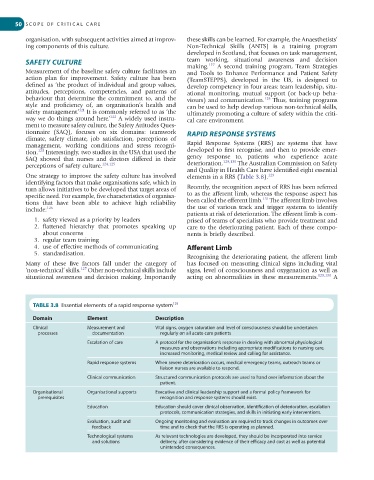
         One strategy to improve the safety culture has involved   elements in a RRS (Table 3.8). 129
         identifying factors that make organisations safe, which in
         turn allows initiatives to be developed that target areas of   Recently, the recognition aspect of RRS has been referred
         specific need. For example, five characteristics of organisa-  to as the afferent limb, whereas the response aspect has
                                                                                       131
         tions  that  have  been  able  to  achieve  high  reliability   been called the efferent limb.  The afferent limb involves
         include: 126                                         the  use  of  various  track  and  trigger  systems  to  identify
                                                              patients at risk of deterioration. The efferent limb is com-
            1.  safety viewed as a priority by leaders        prised of teams of specialists who provide treatment and
            2.  flattened  hierarchy  that  promotes  speaking  up   care to the deteriorating patient. Each of these compo-
               about concerns                                 nents is briefly described.
            3.  regular team training
            4.  use of effective methods of communicating     Afferent Limb
            5.  standardisation.
                                                              Recognising  the  deteriorating  patient,  the  afferent  limb
         Many  of  these  five  factors  fall  under  the  category  of    has  focused  on  measuring  clinical  signs  including  vital
         ‘non-technical’ skills. 127  Other non-technical skills include   signs, level of consciousness and oxygenation as well as
         situational awareness and decision making. Importantly   acting  on  abnormalities  in  these  measurements. 129,130   A


            TABLE 3.8  Essential elements of a rapid response system 129
            Domain            Element               Description
            Clinical          Measurement and       Vital signs, oxygen saturation and level of consciousness should be undertaken
             processes         documentation         regularly on all acute care patients
                              Escalation of care    A protocol for the organisation’s response in dealing with abnormal physiological
                                                     measures and observations including appropriate modifications to nursing care,
                                                     increased monitoring, medical review and calling for assistance.
                              Rapid response systems  When severe deterioration occurs, medical emergency teams, outreach teams or
                                                     liaison nurses are available to respond.
                              Clinical communication  Structured communication protocols are used to hand over information about the
                                                     patient.
            Organisational    Organisational supports  Executive and clinical leadership support and a formal policy framework for
             prerequisites                           recognition and response systems should exist.
                              Education             Education should cover clinical observation, identification of deterioration, escalation
                                                     protocols, communication strategies, and skills in initiating early interventions.
                              Evaluation, audit and   Ongoing monitoring and evaluation are required to track changes in outcomes over
                               feedback              time and to check that the RRS is operating as planned.
                              Technological systems   As relevant technologies are developed, they should be incorporated into service
                               and solutions         delivery, after considering evidence of their efficacy and cost as well as potential
                                                     unintended consequences.

