


Page 75 - ACCCN's Critical Care Nursing
P. 75
52  S C O P E   O F   C R I T I C A L   C A R E


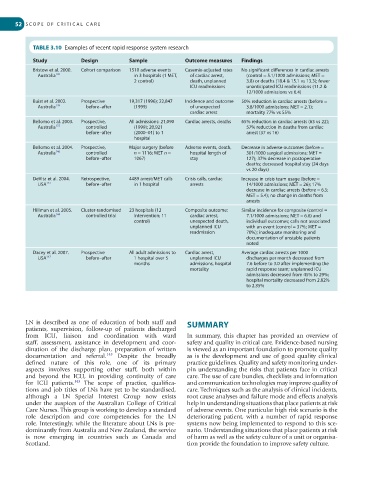
            TABLE 3.10  Examples of recent rapid response system research

            Study           Design         Sample             Outcome measures  Findings
            Bristow et al. 2000.   Cohort comparison  1510 adverse events    Casemix-adjusted rates   No significant differences in cardiac arrests
             Australia 145                   in 3 hospitals (1 MET,   of cardiac arrest,   (control = 5.1/1000 admissions; MET =
                                             2 control)        death, unplanned   3.8) or deaths (18.4 & 15.1 vs 13.3); fewer
                                                               ICU readmissions   unanticipated ICU readmissions (11.2 &
                                                                                  12/1000 admissions vs 6.4)
            Buist et al. 2002.   Prospective   19,317 (1996); 22,847   Incidence and outcome   50% reduction in cardiac arrests (before =
             Australia 139   before–after    (1999)            of unexpected      3.8/1000 admissions; MET = 2.1);
                                                               cardiac arrest     mortality 77% vs 55%
            Bellomo et al. 2003.   Prospective,   All admissions: 21,090   Cardiac arrests, deaths  65% reduction in cardiac arrests (63 vs 22);
             Australia 137   controlled      (1999); 20,921                       57% reduction in deaths from cardiac
                             before–after    (2000–01) to 1                       arrest (37 vs 16)
                                             hospital
            Bellomo et al. 2004.   Prospective,   Major surgery (before   Adverse events, death,   Decrease in adverse outcomes (before =
             Australia 146   controlled      n = 1116; MET n =   hospital length of   301/1000 surgical admissions; MET =
                             before–after    1067)             stay               127); 37% decrease in postoperative
                                                                                  deaths; decreased hospital stay (24 days
                                                                                  vs 20 days)
            DeVita et al. 2004.   Retrospective,   4489 arrest/MET calls   Crisis calls, cardiac   Increase in crisis team usage (before =
             USA 131         before–after    in 1 hospital     arrests            14/1000 admissions; MET = 26); 17%
                                                                                  decrease in cardiac arrests (before = 6.5;
                                                                                  MET = 5.4); no change in deaths from
                                                                                  arrests
            Hillman et al. 2005.   Cluster-randomised   23 hospitals (12   Composite outcome:   Similar incidence for composite (control =
             Australia 144   controlled trial  intervention; 11   cardiac arrest,   7.1/1000 admissions; MET = 6.6) and
                                             control)          unexpected death,   individual outcomes; calls not associated
                                                               unplanned ICU      with an event (control = 37%; MET =
                                                               readmission        70%); inadequate monitoring and
                                                                                  documentation of unstable patients
                                                                                  noted
            Dacey et al. 2007.   Prospective   All adult admissions to   Cardiac arrest,   Average cardiac arrests per 1000
             USA 147         before–after    1 hospital over 5   unplanned ICU    discharges per month decreased from
                                             months            admissions, hospital   7.6 before to 3.0 after implementing the
                                                               mortality          rapid response team; unplanned ICU
                                                                                  admissions decreased from 45% to 29%;
                                                                                  hospital mortality decreased from 2.82%
                                                                                  to 2.35%


         LN  is  described  as  one  of  education  of  both  staff  and   SUMMARY
         patients,  supervision,  follow-up  of  patients  discharged
         from  ICU,  liaison  and  coordination  with  ward     In  summary,  this  chapter  has  provided  an  overview  of
         staff,  assessment,  assistance  in  development  and  coor-  safety and quality in critical care. Evidence-based nursing
         dination  of  the  discharge  plan,  preparation  of  written   is viewed as an important foundation to promote quality
         documentation  and  referral. 143   Despite  the  broadly   as  is  the  development  and  use  of  good  quality  clinical
         defined  nature  of  this  role,  one  of  its  primary     practice guidelines. Quality and safety monitoring under-
         aspects  involves  supporting  other  staff,  both  within     pin understanding the risks that patients face in critical
         and  beyond  the  ICU,  in  providing  continuity  of  care    care. The use of care bundles, checklists and information
         for  ICU  patients. 143   The  scope  of  practice,  qualifica-  and communication technologies may improve quality of
         tions and job titles of LNs have yet to be standardised,   care. Techniques such as the analysis of clinical incidents,
         although  a  LN  Special  Interest  Group  now  exists    root cause analyses and failure mode and effects analysis
         under the auspices of the Australian College of Critical   help in understanding situations that place patients at risk
         Care Nurses. This group is working to develop a standard   of adverse events. One particular high risk scenario is the
         role  description  and  core  competencies  for  the  LN     deteriorating  patient,  with  a  number  of  rapid  response
         role. Interestingly, while the literature about LNs is pre-  systems now being implemented to respond to this sce-
         dominantly from Australia and New Zealand, the service   nario. Understanding situations that place patients at risk
         is  now  emerging  in  countries  such  as  Canada  and   of harm as well as the safety culture of a unit or organisa-
         Scotland.                                            tion provide the foundation to improve safety culture.

