


Page 68 - ACCCN's Critical Care Nursing
P. 68
Quality and Safety 45


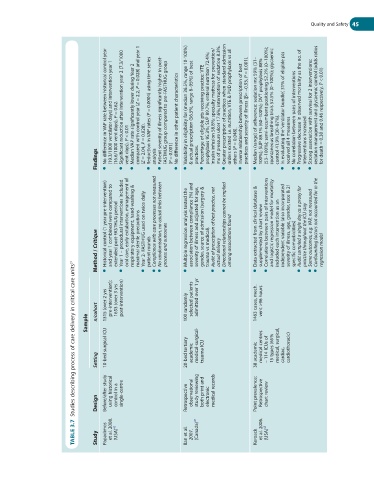
                                      (19.3/1000 ventilator days) and Intervention year 1  No difference in VAP rate between historical control year   (16.6/1000 vent days), P = 0.62. Significant reduction after Intervention year 2 (7.3/1000  Median VAP rate significantly lower during Year 2  compared with control year (Z = 2.2, P = 0.028) and year 1  Reduction in VAP rates (P = 0.0004) using time series  Patient severity of illness significantly higher in post- FASTHUG group compare


                                 Findings  ●   ●   vent days), P < 0.01  ●   (Z = 2.04, P = 0.028).  ●   analysis  ●   (P = 0.001)  ●   ●   practices.  ●   ●   others (P = 0.048).  ●   ●   control 41.9% (30–87%).  ●   received all 4 measures  ●   ●   interventions increased  ●


                                    Historical control (1 year pre-intervention)  and year 1 combined were compared to  extended post-FASTHUG period Year 1 – procedural interventions included  oral care, early extubation, management of  respiratory equipment, hand-washing &   Year 2- FASTHUG used on twice daily  Compliance with care processes not measured No randomisation, no causal links between   Multiple regression analysis tested the  association between compliance (%) and  sever


                                 Method / Critique  ●   ●   maximal sterile precautions  ●   patient rounds  ●   ●   process and outcomes  ●   trauma vs medical).  ●   actual delivery  ●  among associations found  ●   ●   specific comorbidities)  ●   ●   ●   regression model


                         Studies describing process of care delivery in critical care units 57


                                 n/cohort  1315 (over 2 yrs   pre-intervention);   1653 (over 3 yrs   post-intervention)  100 randomly   selected patients   admitted over 1 yr  1463 cases, mech.   vent >96 hours
                              Sample


                                 Setting  10-bed surgical ICU  20-bed tertiary   academic   medical-surgical-  trauma ICU  38 academic   medical centres   – 114 ICUs of    15 types (65%   medical, surgical,   cardiac,   cardiothoracic)


                                    Before/after study   using historical   control in a   single-centre  Retrospective   observational   study reviewing   both print and   electronic   medical records  Point prevalence;   Retrospective   chart review


                                 Design


                         TABLE 3.7   Study  Papadimos   et al. 2008.   (USA) 42  Ilan et al.   2007.   (Canada) 47  Keroack   et al. 2006.   (USA) 45

