


Page 74 - ACCCN's Critical Care Nursing
P. 74
Quality and Safety 51


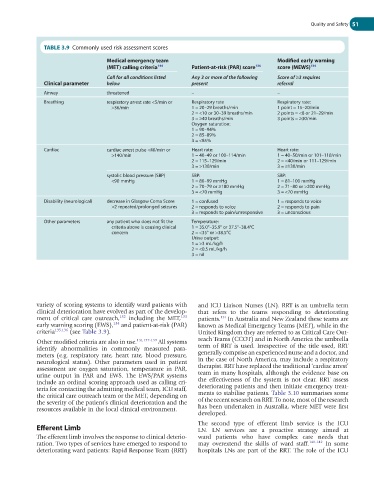
               TABLE 3.9  Commonly used risk assessment scores

                                    Medical emergency team                                  Modified early warning
                                    (MET) calling criteria 144  Patient-at-risk (PAR) score 136  score (MEWS) 134
                                    Call for all conditions listed   Any 3 or more of the following   Score of ≥3 requires
               Clinical parameter   below                       present                     referral
               Airway               threatened                  –                           –
               Breathing            respiratory arrest rate <5/min or   Respiratory rate    Respiratory rate:
                                      >36/min                   1 = 20–29 breaths/min       1 point = 15–20/min
                                                                2 = <10 or 30–39 breaths/min  2 points = <8 or 21–29/min
                                                                3 = ≥40 breaths/min         3 points = ≥30/min
                                                                Oxygen saturation:
                                                                1 = 90–94%
                                                                2 = 85–89%
                                                                3 = <85%
               Cardiac              cardiac arrest pulse <40/min or   Heart rate:           Heart rate:
                                      >140/min                  1 = 40–49 or 100–114/min    1 = 40–50/min or 101–110/min
                                                                2 = 115–129/min             2 = <40/min or 111–129/min
                                                                3 = >130/min                3 = ≥130/min
                                    systolic blood pressure (SBP)   SBP:                    SBP:
                                      <90 mmHg                  1 = 80–99 mmHg              1 = 81–100 mmHg
                                                                2 = 70–79 or ≥180 mmHg      2 = 71–80 or >200 mmHg
                                                                3 = <70 mmHg                3 = <70 mmHg
               Disability (neurological)  decrease in Glasgow Coma Score   1 = confused     1 = responds to voice
                                      >2 repeated/prolonged seizures  2 = responds to voice  2 = responds to pain
                                                                3 = responds to pain/unresponsive  3 = unconscious
               Other parameters     any patient who does not fit the   Temperature:
                                      criteria above is causing clinical   1 = 35.0°–35.9° or 37.5°–38.4°C
                                      concern                   2 = <35° or >38.5°C
                                                                Urine output:
                                                                1 = >3 mL/kg/h
                                                                2 = <0.5 mL/kg/h
                                                                3 = nil


             variety of scoring systems to identify ward patients with   and ICU Liaison Nurses (LN). RRT is an umbrella term
             clinical deterioration have evolved as part of the develop-  that  refers  to  the  teams  responding  to  deteriorating
             ment  of  critical  care  outreach, 132   including  the  MET, 133    patients.  In Australia and New Zealand these teams are
                                                                         131
             early warning scoring (EWS), 134  and patient-at-risk (PAR)   known as Medical Emergency Teams (MET), while in the
             criteria 135,136  (see Table 3.9).                   United Kingdom they are referred to as Critical Care Out-
             Other modified criteria are also in use. 131,137-139  All systems   reach Teams (CCOT) and in North America the umbrella
             identify  abnormalities  in  commonly  measured  para-  term  of  RRT  is  used.  Irrespective  of  the  title  used,  RRT
             meters  (e.g.  respiratory  rate,  heart  rate,  blood  pressure,     generally comprise an experienced nurse and a doctor, and
             neurological  status).  Other  parameters  used  in  patient   in the case of North America, may include a respiratory
             assessment  are  oxygen  saturation,  temperature  in  PAR,   therapist. RRT have replaced the traditional ‘cardiac arrest’
             urine  output  in  PAR  and  EWS.  The  EWS/PAR  systems   team in many hospitals, although the evidence base on
             include an ordinal scoring approach used as calling cri-  the  effectiveness  of  the  system  is  not  clear.  RRT  assess
             teria for contacting the admitting medical team, ICU staff,   deteriorating patients and then initiate emergency treat-
             the critical care outreach team or the MET, depending on   ments to stabilise patients. Table 3.10 summarises some
             the severity of the patient’s clinical deterioration and the   of the recent research on RRT. To note, most of the research
             resources available in the local clinical environment.  has been undertaken in Australia, where MET were first
                                                                  developed.
                                                                  The  second  type  of  efferent  limb  service  is  the  ICU
             Efferent Limb                                        LN.  LN  services  are  a  proactive  strategy  aimed  at
             The efferent limb involves the response to clinical deterio-  ward  patients  who  have  complex  care  needs  that
             ration. Two types of services have emerged to respond to   may  overextend  the  skills  of  ward  staff. 140-142   In  some
             deteriorating ward patients: Rapid Response Team (RRT)   hospitals LNs are part of the RRT. The role of the ICU

