


Page 804 - ACCCN's Critical Care Nursing
P. 804
A P P E N D I X   C   N O R M A L   V A L U E S 781


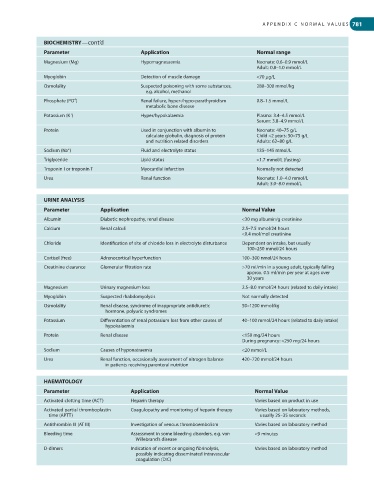
               BIOCHEMISTRY—cont’d
               Parameter                       Application                           Normal range
               Magnesium (Mg)                  Hypomagnesaemia                       Neonate: 0.6–0.9 mmol/L
                                                                                     Adult: 0.8–1.0 mmol/L
               Myoglobin                       Detection of muscle damage            <70 μg/L
               Osmolality                      Suspected poisoning with some substances,   280–300 mmol/kg
                                                 e.g. alcohol, methanol
               Phosphate (PO ) 4               Renal failure, hyper-/hypo-parathyroidism   0.8–1.5 mmol/L
                                                 metabolic bone disease
                        +
               Potassium (K )                  Hyper/hypokalaemia                    Plasma: 3.4–4.5 mmol/L
                                                                                     Serum: 3.8–4.9 mmol/L
               Protein                         Used in conjunction with albumin to   Neonate: 40–75 g/L
                                                 calculate globulin, diagnosis of protein   Child <2 years: 50–75 g/L
                                                 and nutrition related disorders     Adults: 62–80 g/L
               Sodium (Na )                    Fluid and electrolyte status          135–145 mmol/L
                       +
               Triglyceride                    Lipid status                          <1.7 mmol/L (fasting)
               Troponin I or troponin T        Myocardial infarction                 Normally not detected
               Urea                            Renal function                        Neonate: 1.0–4.0 mmol/L
                                                                                     Adult: 3.0–8.0 mmol/L

               URINE ANALYSIS
               Parameter          Application                                   Normal Value
               Albumin            Diabetic nephropathy, renal disease           <30 mg albumin/g creatinine
               Calcium            Renal calculi                                 2.5–7.5 mmol/24 hours
                                                                                <0.4 mol/mol creatinine
               Chloride           Identification of site of chloride loss in electrolyte disturbance  Dependent on intake, but usually
                                                                                  100–250 mmol/24 hours
               Cortisol (free)    Adrenocortical hyperfunction                  100–300 nmol/24 hours
               Creatinine clearance  Glomerular filtration rate                 >70 ml/min in a young adult, typically falling
                                                                                  approx. 0.5 ml/min per year at ages over
                                                                                  30 years
               Magnesium          Urinary magnesium loss                        2.5–8.0 mmol/24 hours (related to daily intake)
               Myoglobin          Suspected rhabdomyolysis                      Not normally detected
               Osmolality         Renal disease, syndrome of inappropriate antidiuretic   50–1200 mmol/kg
                                    hormone, polyuric syndromes
               Potassium          Differentiation of renal potassium loss from other causes of   40–100 mmol/24 hours (related to daily intake)
                                    hypokalaemia
               Protein            Renal disease                                 <150 mg/24 hours
                                                                                During pregnancy: <250 mg/24 hours
               Sodium             Causes of hyponatraemia                       <20 mmol/L
               Urea               Renal function, occasionally assessment of nitrogen balance   420–720 mmol/24 hours
                                    in patients receiving parenteral nutrition

               HAEMATOLOGY
               Parameter                    Application                             Normal Value
               Activated clotting time (ACT)  Heparin therapy                       Varies based on product in use
               Activated partial thromboplastin   Coagulopathy and monitoring of heparin therapy  Varies based on laboratory methods,
                 time (APTT)                                                          usually 25–35 seconds
               Antithrombin III (AT III)    Investigation of venous thromboembolism  Varies based on laboratory method
               Bleeding time                Assessment in some bleeding disorders, e.g. von   <9 minutes
                                             Willebrand’s disease
               D-dimers                     Indication of recent or ongoing fibrinolysis,   Varies based on laboratory method
                                             possibly indicating disseminated intravascular
                                             coagulation (DIC)

