


Page 49 - E BOOK ENGINE MECHANICAL M2
P. 49
1. GENERAL


           6. DIESEL KNOCKING
           (1) Occurrence of Diesel Knocking
           Air-fuel mixture accumulated during the ignition delay period is combusted at a stretch to increase
           the  pressure  rapidly  in  the  flame  propagation  period.  Diesel  knocking  occurs  if  the  pressure  in-
           creases too rapidly. The knocking in the diesel engine is physically the same as that in the gasoline
           engine.
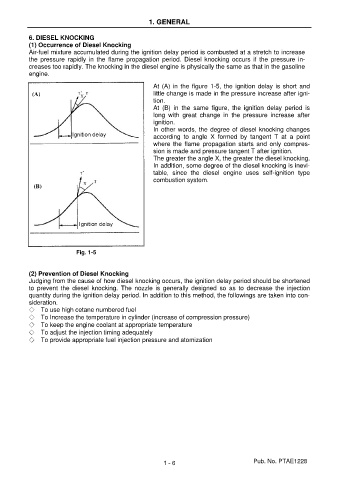
                                                       At  (A)  in  the  figure  1-5,  the  ignition  delay  is  short  and
            (A)              X                         little change is made in the pressure increase after igni-
                                                       tion.
                                                       At  (B)  in  the  same  figure,  the  ignition  delay  period  is
                                                       long  with  great  change  in  the  pressure  increase  after
                                                       ignition.
                                                       In other words, the degree of diesel knocking changes
                                                       according  to  angle  X  formed  by  tangent  T  at  a  point
                                                       where  the  flame  propagation  starts  and  only  compres-
                                                       sion is made and pressure tangent T after ignition.
                                                       The greater the angle X, the greater the diesel knocking.
                                                       In addition, some degree of the diesel knocking is inevi-
                                                       table,  since  the  diesel  engine  uses  self-ignition  type
                                                       combustion system.
                              X
             (B)


                            Fig. 1-5


           (2) Prevention of Diesel Knocking
           Judging from the cause of how diesel knocking occurs, the ignition delay period should be shortened
           to  prevent  the  diesel  knocking.  The  nozzle  is  generally  designed  so  as  to  decrease  the  injection
           quantity during the ignition delay period. In addition to this method, the followings are taken into con-
           sideration.
           ◇  To use high cetane numbered fuel
           ◇  To Increase the temperature in cylinder (increase of compression pressure)
           ◇  To keep the engine coolant at appropriate temperature
           ◇  To adjust the injection timing adequately
           ◇  To provide appropriate fuel injection pressure and atomization


                                                          1 - 6                           Pub. No. PTAE1228

