


Page 48 - E BOOK ENGINE MECHANICAL M2
P. 48
1. GENERAL


           5. COMBUSTION PROCESS
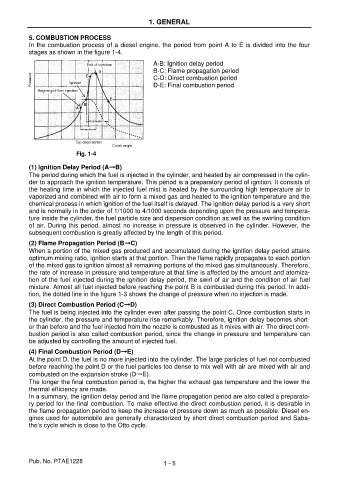
           In the combustion process of a diesel engine, the period from point A to E is divided into the four
           stages as shown in the figure 1-4.
                                                       A-B: Ignition delay period
                                                       B-C: Flame propagation period
                                                       C-D: Direct combustion period
                                                       D-E: Final combustion period


                            Fig. 1-4

           (1) Ignition Delay Period (A→B)
                                       →
                                       →→
           The period during which the fuel is injected in the cylinder, and heated by air compressed in the cylin-
           der to approach the ignition temperature. This period is a preparatory period of ignition. It consists of
           the heating time in which the injected fuel mist is heated by the surrounding high temperature air to
           vaporized and combined with air to form a mixed gas and heated to the ignition temperature and the
           chemical process in which ignition of the fuel itself is delayed. The ignition delay period is a very short
           and is normally in the order of 1/1000 to 4/1000 seconds depending upon the pressure and tempera-
           ture inside the cylinder, the fuel particle size and dispersion condition as well as the swirling condition
           of air. During this period, almost no increase in pressure is observed in the cylinder. However, the
           subsequent combustion is greatly affected by the length of this period.

           (2) Flame Propagation Period (B→C)
                                             →
                                             →→
           When a portion of the mixed gas produced and accumulated during the ignition delay period attains
           optimum mixing ratio, ignition starts at that portion. Then the flame rapidly propagates to each portion
           of the mixed gas to ignition almost all remaining portions of the mixed gas simultaneously. Therefore,
           the rate of increase in pressure and temperature at that time is affected by the amount and atomiza-
           tion of the fuel injected during the ignition delay period, the swirl of air and the condition of air fuel
           mixture. Almost all fuel injected before reaching the point B is combusted during this period. In addi-
           tion, the dotted line in the figure 1-3 shows the change of pressure when no injection is made.
           (3) Direct Combustion Period (C→D)
                                             →→
                                             →
           The fuel is being injected into the cylinder even after passing the point C. Once combustion starts in
           the cylinder, the pressure and temperature rise remarkably. Therefore, ignition delay becomes short-
           er than before and the fuel injected from the nozzle is combusted as it mixes with air. The direct com-
           bustion period is also called combustion period, since the change in pressure and temperature can
           be adjusted by controlling the amount of injected fuel.

           (4) Final Combustion Period (D→E)
                                           →
                                           →→
           At the point D, the fuel is no more injected into the cylinder. The large particles of fuel not combusted
           before reaching the point D or the fuel particles too dense to mix well with air are mixed with air and
           combusted on the expansion stroke (D→E).
           The longer the final combustion period is, the higher the exhaust gas temperature and the lower the
           thermal efficiency are made.
           In a summary, the ignition delay period and the flame propagation period are also called a preparato-
           ry period for the final combustion. To make effective the direct combustion period, it is desirable in
           the flame propagation period to keep the increase of pressure down as much as possible. Diesel en-
           gines used for automobile are generally characterized by short direct combustion period and Saba-
           the’s cycle which is close to the Otto cycle.


           Pub. No. PTAE1228
                                                          1 - 5

