


Page 44 - E BOOK ENGINE MECHANICAL M2
P. 44
1. GENERAL


           1. MAJOR OPERATIONAL CHARACTERISTICS
           A diesel engine is essentially the same reciprocating engine as a gasoline engine in which the com-
           bustion pressure causes the pistons to make reciprocating motion. The followings are major opera-
           tional characteristics of the diesel engine.

           ◇  The  air  only  is  compressed  to  a  high  temperature  (300  to  500 )  and  a  high  pressure
               (Approx.3MPa), and the fuel injected subsequently there for spontaneous ignition and combus-
               tion.
           ◇  The  engine  output  control  is  done  by  adjusting  the  fuel  injection  amount  into  the  cylinders
               through the injectors, and it is not like gasoline engine so that the engine output is controlled by
               the intake air amount with the throttle valve.


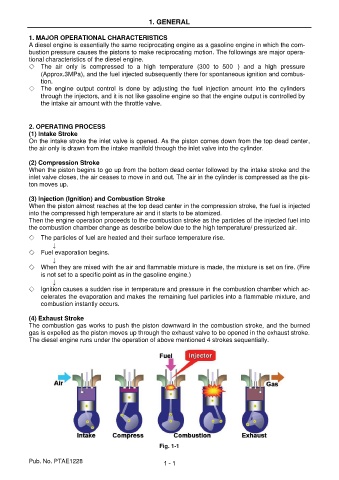
           2. OPERATING PROCESS
           (1) Intake Stroke
           On the intake stroke the inlet valve is opened. As the piston comes down from the top dead center,
           the air only is drawn from the intake manifold through the inlet valve into the cylinder.

           (2) Compression Stroke
           When the piston begins to go up from the bottom dead center followed by the intake stroke and the
           inlet valve closes, the air ceases to move in and out. The air in the cylinder is compressed as the pis-
           ton moves up.

           (3) Injection (Ignition) and Combustion Stroke
           When the piston almost reaches at the top dead center in the compression stroke, the fuel is injected
           into the compressed high temperature air and it starts to be atomized.
           Then the engine operation proceeds to the combustion stroke as the particles of the injected fuel into
           the combustion chamber change as describe below due to the high temperature/ pressurized air.

           ◇  The particles of fuel are heated and their surface temperature rise.
                    ↓
           ◇  Fuel evaporation begins.
                    ↓
           ◇  When they are mixed with the air and flammable mixture is made, the mixture is set on fire. (Fire
               is not set to a specific point as in the gasoline engine.)
                    ↓
           ◇  Ignition causes a sudden rise in temperature and pressure in the combustion chamber which ac-
               celerates the evaporation and makes the remaining fuel particles into a flammable mixture, and
               combustion instantly occurs.

           (4) Exhaust Stroke
           The combustion gas works to push the piston downward in the combustion stroke, and the burned
           gas is expelled as the piston moves up through the exhaust valve to be opened in the exhaust stroke.
           The diesel engine runs under the operation of above mentioned 4 strokes sequentially.


                                                         Fig. 1-1


           Pub. No. PTAE1228
                                                          1 - 1

