


Page 46 - E BOOK ENGINE MECHANICAL M2
P. 46
1. GENERAL


                                                       <Diesel Engine>
                                                       - The output of the diesel engine is controlled by adjust-
                                                       ing the injected fuel amount in the cylinder -
                                                       On the diesel engine the amount of air to be sucked into
                                                       the cylinders is almost constant regardless the engine
                                                       speed.  The output control is achieved by adjusting the
                                                       amount of the fuel injected into the cylinders so that the
                                                       produced combustion power is changed.

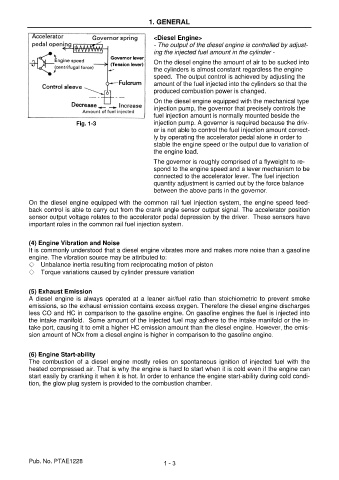
                                                       On the diesel engine equipped with the mechanical type
                                                       injection pump, the governor that precisely controls the
                                                       fuel injection amount is normally mounted beside the
                            Fig. 1-3                   injection pump. A governor is required because the driv-
                                                       er is not able to control the fuel injection amount correct-
                                                       ly by operating the accelerator pedal alone in order to
                                                       stable the engine speed or the output due to variation of
                                                       the engine load.
                                                       The governor is roughly comprised of a flyweight to re-
                                                       spond to the engine speed and a lever mechanism to be
                                                       connected to the accelerator lever. The fuel injection
                                                       quantity adjustment is carried out by the force balance
                                                       between the above parts in the governor.

           On the diesel engine equipped with the common rail fuel injection system, the engine speed feed-
           back control is able to carry out from the crank angle sensor output signal. The accelerator position
           sensor output voltage relates to the accelerator pedal depression by the driver.  These sensors have
           important roles in the common rail fuel injection system.


           (4) Engine Vibration and Noise
           It is commonly understood that a diesel engine vibrates more and makes more noise than a gasoline
           engine. The vibration source may be attributed to:
           ◇  Unbalance inertia resulting from reciprocating motion of piston
           ◇  Torque variations caused by cylinder pressure variation


           (5) Exhaust Emission
           A  diesel  engine  is  always  operated  at  a  leaner  air/fuel  ratio  than  stoichiometric  to  prevent  smoke
           emissions, so the exhaust emission contains excess oxygen. Therefore the diesel engine discharges
           less CO and HC in comparison to the gasoline engine. On gasoline engines the fuel is injected into
           the intake manifold.  Some amount of the injected fuel may adhere to the intake manifold or the in-
           take port, causing it to emit a higher HC emission amount than the diesel engine. However, the emis-
           sion amount of NOx from a diesel engine is higher in comparison to the gasoline engine.


           (6) Engine Start-ability
           The  combustion  of  a  diesel  engine  mostly  relies  on  spontaneous  ignition  of  injected  fuel  with  the
           heated compressed air. That is why the engine is hard to start when it is cold even if the engine can
           start easily by cranking it when it is hot. In order to enhance the engine start-ability during cold condi-
           tion, the glow plug system is provided to the combustion chamber.


           Pub. No. PTAE1228
                                                          1 - 3

