


Page 101 - Concise Pathology for Exam Preparation ( PDFDrive )
P. 101
86 SECTION I General Pathology
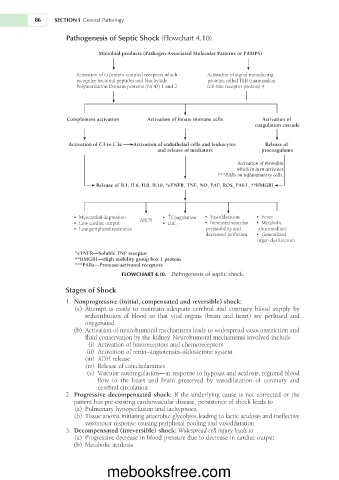
Pathogenesis of Septic Shock (Flowchart 4.10)
r
Microbial products (PathogenAssociated Molecular Patterns PAMPS)
o
Activation of G proteincoupled receptors which Activation of signal transducing
recognize bacterial peptides and Nucleotide proteins called TLR (mammalian
Polymerization Domain proteins (NOD) 1 and 2 tolllike receptor protein) 4
o
f
Complement activation Activation innate immune cells Activation f
o
coagulation cascade
o
o
t
f
f
o
Activation C3 C3a Activation endothelial cells and leukocytes Release
f
o
and release mediators procoagulants
f
o
Activation of thrombin
which in turn activates
***PARs on inflammatory cells.
o
f
Release IL1, IL6, IL8, IL10, *sTNFR, TNF, NO, PAF, ROS, PAI1, **HMGB1
• Myocardial depression ARDS • ↑Coagulation • Vasodilatation • Fever
• Low cardiac output • DIC • Increased vascular • Metabolic
• Low peripheral resistance permeability and abnormalities
decreased perfusion • Generalized
organ dysfunction
*sTNFR—Soluble TNF receptor
1
**HMGB1—High mobility group box protein
***PARs—Proteaseactivated receptors
FLOWCHART 4.10. Pathogenesis of septic shock.
Stages of Shock
Nonprogressive (initial, compensated and reversible) shock:
1.
(a)
Attempt made maintain adequate cerebral and coronary blood supply by
is
to
of
redistribution blood so that vital organs (brain and heart) are perfused and
oxygenated.
to
Activation
of
(b) neurohumoral mechanisms leads widespread vasoconstriction and
fluid conservation by the kidney. Neurohumoral mechanisms involved include
of
(i) Activation baroreceptors and chemoreceptors
(ii) Activation renin–angiotensin–aldosterone system
of
(iii) ADH release
(iv) Release catecholamines
of
(v) Vascular autoregulation—in response hypoxia and acidosis, regional blood
to
flow to the heart and brain preserved by vasodilatation of coronary and
cerebral circulation
If
is
or
Progressive decompensated shock:
2. the underlying cause not corrected the
of
patient has pre-existing cardiovascular disease, persistence shock leads to
(a)
Pulmonary hypoperfusion and tachypnoea
(
t
Tissue anoxia initiating anaerobic glycolysis leading lactic acidosis and ineffective
o
b
)
vasomotor response causing peripheral pooling and vasodilatation
3.
Decompensated (irreversible) shock: Widespread cell injury leads to
Progressive decrease blood pressure due decrease cardiac output
to
in
(a)
in
(b)
Metabolic acidosis
mebooksfree.com

