


Page 100 - Concise Pathology for Exam Preparation ( PDFDrive )
P. 100
4 Haemodynamic Disorders, Thrombosis and Shock 85
Deficient filling
(b)
Cardiac tamponade
Obstruction outflow
(c)
to
Pulmonary embolism
(i)
Ball valve thrombus
(ii)
3. due loss vascular tone and peripheral pooling blood
Neurogenic shock: Occurs
of
to
of
or
following anaesthesia spinal cord injury.
a
4.
of
an
Anaphylactic shock: Occurs when allergic response triggers quick release mast
in
cell mediators large quantities (histamine, prostaglandins and leukotrienes) leading
to systemic vasodilatation (associated with hypotension), increased vascular permeabil-
in
to
to
ity and bronchoconstriction (leading difficulty breathing). Shock can lead death
if
of
a
in matter minutes left untreated.
5 . when there widespread endothelial injury and activation due to
s
Septic shock: Occurs
i
(a)
Severe bacterial infections
(i) Predominantly Gram-positive infections (streptococci and pneumococci)
(ii) Gram-negative infections (E. coli, Proteus, Klebsiella and Pseudomonas)
Fungal
(b) rickettsial sepsis
or
T
(c)
Super antigens (polyclonal lymphocyte activators that induce release high
of
to
levels cytokines that lead vasodilatation, hypotension and shock)
of
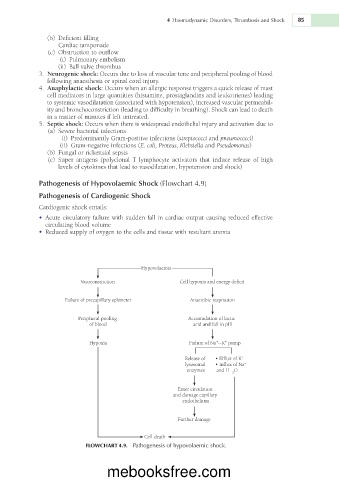
Pathogenesis of Hypovolaemic Shock (Flowchart 4.9)
Pathogenesis of Cardiogenic Shock
Cardiogenic shock entails:
in
• �Acute circulatory failure with sudden fall cardiac output causing reduced effective
circulating blood volume
of
• �Reduced supply oxygen the cells and tissue with resultant anoxia
to
Hypovolaemia
Vasoconstriction Cell hypoxia and energy deficit
Failure of precapillary sphincter Anaerobic respiration
Peripheral pooling Accumulation of lactic
of blood acid and fall in pH
+
Hypoxia Failure of Na K + pump
Release of • Efflux of K +
lysosomal • Influx of Na +
enzymes and H O
2
Enter circulation
and damage capillary
endothelium
Further damage
Cell death
FLOWCHART 4.9. Pathogenesis of hypovolaemic shock.
mebooksfree.com

