


Page 104 - Concise Pathology for Exam Preparation ( PDFDrive )
P. 104
5


                                     Diseases of Immunity


             The human immune system is a complex network of signals, which controls responses to anti-
               genic stimulation and protects us from diseases. The components of the immune system are:
               •  Antigen-specific (recognize and act against particular antigens)
               •  Systemic  (elicit a  response which  affects  the entire body  and  is  not  confined to  the
                 initial affected site)
               •  Have memory (recognize and mount an even stronger attack to the same antigen  the
                 next time)
             The functions of the immune system are:
               •  To  provide  resistance  against  invading  pathogens  (viruses,  bacteria,  parasites,  etc.)
                 and foreign  material (eg,  transplanted organ)
               •  To remove 'worn-out' cells (eg, aged cells or tissue debris from site of injury or disease)
               •  To provide primary defence against cancer
             Inappropriate immune responses may manifest as
               •  Allergies
               •  Autoimmune diseases
             An antigen is a substance (usually a protein) that evokes the production of antibodies. An
               epitope, also known  as 'antigenic determinant',  is the part of an antigen  that is recog-
               nized by the immune system , specifically by antibodies, B cells or T cells.
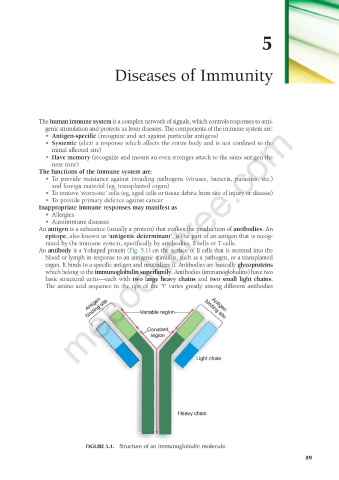
             An antibody is a Y-shaped protein (Fig. 5.1) on  the surface  of B cells that is secreted into the
               blood or lymph in response to an antigenic stimulus, such as a pathogen, or a transplanted
               organ. It binds to a specific antigen and neutralizes it. Antibodies are basically glycoproteins
               which belong to the immunoglobulin superfamily. Antibodies (immunoglobulins) have two
               basic structural  units--each  with two  large  heavy  chains  and two  small light chains.
               The  amino  acid sequence  in the  tips  of  the  'Y'  varies  greatly  among  different antibodies


                                                        Heavy chain


                            FIGURE 5.1.  Structure of an immunoglobulin mo lecule.

                                                                                               89

