


Page 97 - Concise Pathology for Exam Preparation ( PDFDrive )
P. 97
82    SECTION I    General Pathology


                                                  o
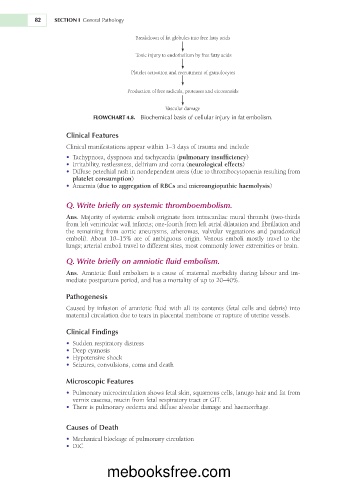
                                           Breakdown    fat globules into free fatty acids
                                                   f


                                           Toxic injury to    endothelium by free fatty acids

                                         Platelet activation   and recruitment of granulocytes

                                        Production of free radicals, proteases   and eicosanoids
                                                    Vascular    damage
                              FLOWCHART 4.8.    Biochemical basis of cellular injury in fat embolism.

                     Clinical Features

                     Clinical   manifestations   appear   within   1–3   days     trauma   and   include
                                                            of
                        •	�Tachypnoea,   dyspnoea   and   tachycardia  (pulmonary insufficiency)
                        •	�Irritability,  restlessness,   delirium   and   coma  (neurological effects)
                                                                to
                        •	�Diffuse   petechial   rash     nondependent   areas   (due     thrombocytopaenia   resulting   from
                                         in
                       platelet consumption)
                        •	�Anaemia  (due to aggregation of RBCs and   microangiopathic haemolysis)

                     Q.   Write briefly on systemic thromboembolism.
                                 of
                     Ans.   Majority     systemic   emboli   originate   from   intracardiac   mural   thrombi   (two-thirds
                     from   left   ventricular   wall   infarcts;   one-fourth   from   left   atrial   dilatation   and   fibrillation   and

                     the    remaining  from  aortic  aneurysms,  atheromas,  valvular  vegetations  and  paradoxical


                     emboli).    About  10–15%  are      ambiguous  origin.  Venous  emboli  mostly  travel      the


                                                                                        to


                                              of

                                                                                      or
                     lungs;   arterial   emboli   travel     different   sites,   most   commonly   lower   extremities     brain.
                                            to
                     Q.   Write briefly on amniotic fluid embolism.
                                                        of


                                                 a


                     Ans.    Amniotic  fluid  embolism       cause     maternal  morbidity  during  labour  and  im-
                                               is
                                                                 to
                                                             of
                     mediate   postpartum   period,   and   has     mortality     up     20–40%.
                                                   a
                     Pathogenesis


                     Caused    by  infusion      amniotic  fluid  with  all  its  contents  (fetal  cells  and  debris)  into


                                      of


                                          to
                                                in
                                                                            of
                                                                   or
                     maternal   circulation   due     tears     placental   membrane     rupture     uterine   vessels.
                     Clinical Findings
                        •	�Sudden   respiratory  distress
                        •	�Deep   cyanosis
                        •	�Hypotensive   shock
                        •	�Seizures,   convulsions,   coma   and   death
                     Microscopic Features
                        •	�Pulmonary  microcirculation   shows   fetal   skin,   squamous   cells,   lanugo   hair   and   fat   from
                       vernix   caseosa,   mucin   from   fetal   respiratory   tract     GIT.
                                                               or
                             is
                        •	�There     pulmonary  oedema   and   diffuse   alveolar   damage   and   haemorrhage.
                     Causes of Death
                                         of
                        •	�Mechanical   blockage     pulmonary  circulation
                        •	�DIC
                                  mebooksfree.com

