


Page 105 - Concise Pathology for Exam Preparation ( PDFDrive )
P. 105
90 SECTION I General Pathology
i
and s labelled the ‘variable region’. It is composed of 110–130 amino acids which give the
t
i
antibody s specificity for binding antigen. The variable region includes the ends of the light
and heavy chains. Digestion with the protease papain cleaves antibody molecules into three
fragments. Two fragments are identical and contain the antigen-binding activity. These are
termed the ‘Fab fragments’ (for fragment antigen binding). The other fragment contains no
antigen-binding activity but was originally observed to crystallize readily, and for this reason
was named the ‘Fc fragment’ (for Fragment crystallizable). The constant region deter-
mines the mechanism used to destroy the antigen.
Antibodies are divided into five major classes: IgM, IgG, IgA, IgD and IgE, based on their
constant region structure. IgMs have mu-chains; IgAs have alpha-chains; IgEs have
epsilon-chains and IgDs have delta-chains. Differences in heavy chain polypeptides
determine the function of different immunoglobulins. The polypeptide protein sequences
responsible for these differences are found primarily in the Fc fragment. While there are
five different types of heavy chains, there are only two main types of light chains: kappa (k)
and lambda (l). Each antibody binds to a specific antigen. The antigenic substance may be
from the external environment or from within the body.
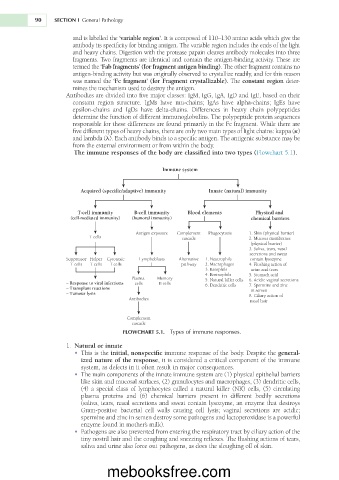
The immune responses of the body are classified into two types (Flowchart 5.1).
Immune system
Acquired (specific/adaptive) immunity Innate (natural) immunity
Tcell immunity Bcell immunity Blood elements Physical and
(cellmediated immunity) (humoral immunity)
chemical barriers
Antigen exposure Complement Phagocytosis 1. Skin (physical barrier)
T cells cascade 2. Mucous membranes
(physical barrier)
3. Saliva, tears, nasal
secretions and sweat
Suppressor Helper Cytotoxic Lymphoblasts Alternative 1. Neutrophils contain lysozyme
T cells T cells T cells pathway 2. Macrophages 4. Flushing action of
3. Basophils urine and tears
4. Eosinophils 5. Stomach acid
Plasma Memory 5. Natural killer cells 6. Acidic vaginal secretions
– Response to viral infections cells B cells 6. Dendritic cells 7. Spermine and zinc
– Transplant reactions in semen
– Tumour lysis 8. Ciliary action of
Antibodies nasal hair
Complement
cascade
FLOWCHART 5.1. Types of immune responses.
1.
�Natural or innate
• �This is the initial, nonspecific immune response of the body. Despite the general-
ized nature of the response, it is considered a critical component of the immune
system, as defects in it often result in major consequences.
• �The main components of the innate immune system are (1) physical epithelial barriers
like skin and mucosal surfaces, (2) granulocytes and macrophages, (3) dendritic cells,
a
o
(4) a special class f lymphocytes called natural killer (NK) cells, (5) circulating
plasma proteins and (6) chemical barriers present in different bodily secretions
(saliva, tears, nasal secretions and sweat contain lysozyme, an enzyme that destroys
Gram-positive bacterial cell walls causing cell lysis; vaginal secretions are acidic;
spermine and zinc in semen destroy some pathogens and lactoperoxidase is a powerful
enzyme found in mother’s milk).
• �Pathogens are also prevented from entering the respiratory tract by ciliary action of the
tiny nostril hair and the coughing and sneezing reflexes. The flushing actions of tears,
saliva and urine also force out pathogens, as does the sloughing off of skin.
mebooksfree.com

