


Page 107 - Concise Pathology for Exam Preparation ( PDFDrive )
P. 107
92 SECTION I General Pathology
Stem cell Prepro B cell PreB cell Immature (early) Mature B Plasma cell
B cell cell
CD34 CD19 CD19 CD19 CD19 Clg
HLADR CD10 CD20 CD20 CD20 CD138
HLADR CD10 CD21 S /md
CD34 CD45 CD45
CD45 CD123 CD10
CD93 CD127 CD93
PAX5 PAX5 PAX5, IL4R, 7R
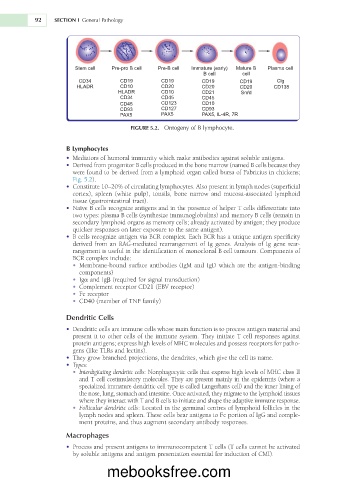
FIGURE 5.2. Ontogeny of B lymphocyte.
B Lymphocytes
• �Mediators of humoral immunity which make antibodies against soluble antigens.
• �Derived from progenitor B cells produced in the bone marrow (named B cells because they
were found to be derived from a lymphoid organ called bursa of Fabricius in chickens;
Fig. 5.2).
• �Constitute 10–20% of circulating lymphocytes. Also present in lymph nodes (superficial
cortex), spleen (white pulp), tonsils, bone narrow and mucosa-associated lymphoid
tissue (gastrointestinal tract).
• �Naïve B cells recognize antigens and in the presence of helper T cells differentiate into
two types: plasma B cells (synthesize immunoglobulins) and memory B cells (remain in
secondary lymphoid organs as memory cells; already activated by antigen; they produce
quicker responses on later exposure to the same antigen).
• �B cells recognize antigen via BCR complex. Each BCR has a unique antigen specificity
derived from an RAG-mediated rearrangement of Ig genes. Analysis of Ig gene rear-
rangement is useful in the identification of monoclonal B cell tumours. Components of
BCR complex include:
• �Membrane-bound surface antibodies (IgM and IgD which are the antigen-binding
components)
• �Iga and Igb (required for signal transduction)
• �Complement receptor CD21 (EBV receptor)
• �Fc receptor
• �CD40 (member of TNF family)
Dendritic Cells
• �Dendritic cells are immune cells whose main function is to process antigen material and
present it to other cells of the immune system. They initiate T cell responses against
protein antigens; express high levels of MHC molecules and possess receptors for patho-
gens (like TLRs and lectins).
• �They grow branched projections, the dendrites, which give the cell its name.
• �Types:
• �Interdigitating dendritic cells: Nonphagocytic cells that express high levels of MHC class II
and T cell costimulatory molecules. They are present mainly in the epidermis (where a
specialized immature dendritic cell type is called Langerhans cell) and the inner lining of
the nose, lung, stomach and intestine. Once activated, they migrate to the lymphoid tissues
where they interact with T and B cells to initiate and shape the adaptive immune response.
• �Follicular dendritic cells: Located in the germinal centres of lymphoid follicles in the
lymph nodes and spleen. These cells bear antigens to Fc portion of IgG and comple-
ment proteins, and thus augment secondary antibody responses.
Macrophages
• �Process and present antigens to immunocompetent T cells (T cells cannot be activated
by soluble antigens and antigen presentation essential for induction of CMI).
mebooksfree.com

