


Page 142 - Concise Pathology for Exam Preparation ( PDFDrive )
P. 142
6  Neoplasia  127

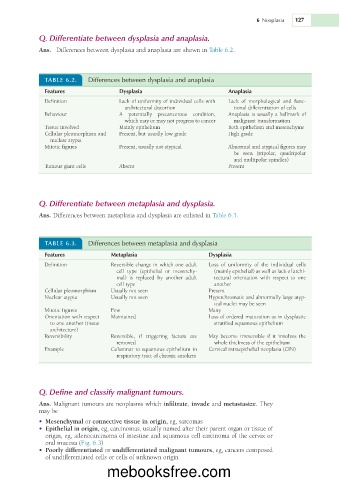
             Q. Differentiate between dysplasia and anaplasia.

             Ans.   Differences between dysplasia and anaplasia are shown in Table 6.2.


               TABLE 6.2.   Differences between dysplasia and anaplasia
               Features               Dysplasia                        Anaplasia
               Definition             Lack of uniformity of individual cells with   Lack  of  morphological  and  func-
                                       architectural distortion          tional differentiation of cells
               Behaviour              A  potentially  precancerous  condition,   Anaplasia is usually a hallmark of
                                       which may or may not progress to cancer  malignant transformation
               Tissue involved        Mainly epithelium                Both epithelium and mesenchyme
               Cellular pleomorphism and   Present, but usually low grade  High grade
                 nuclear atypia
               Mitotic figures        Present, usually not atypical    Abnormal and atypical figures may
                                                                         be  seen  (tripolar,  quadripolar
                                                                         and multipolar spindles)
               Tumour giant cells     Absent                           Present


             Q. Differentiate between metaplasia and dysplasia.

             Ans. Differences between metaplasia and dysplasia are enlisted in Table 6.3.


               TABLE 6.3.   Differences between metaplasia and dysplasia
               Features            Metaplasia                    Dysplasia
               Definition          Reversible change in which one adult   Loss  of  uniformity  of  the  individual  cells
                                     cell  type  (epithelial  or  mesenchy-  (mainly epithelial) as well as lack of archi-
                                     mal)  is  replaced  by  another  adult   tectural  orientation  with  respect  to  one
                                     cell type                     another
               Cellular pleomorphism  Usually not seen           Present
               Nuclear atypia      Usually not seen              Hyperchromatic and abnormally large atyp-
                                                                   ical nuclei may be seen
               Mitotic figures     Few                           Many
               Orientation with respect   Maintained             Loss of ordered maturation as in dysplastic
                 to one another (tissue                            stratified squamous epithelium
                 architecture)
               Reversibility       Reversible,  if  triggering  factors  are     May  become  irreversible  if  it  involves  the
                                     removed                       whole thickness of the epithelium
               Example             Columnar to squamous epithelium in   Cervical intraepithelial neoplasia (CIN)
                                     respiratory tract of chronic smokers


             Q. Define and classify malignant tumours.

             Ans. Malignant tumours are neoplasms which infiltrate, invade and metastasize. They
             may be
             •  Mesenchymal or connective tissue in origin, eg, sarcomas
             •  Epithelial in origin, eg, carcinomas, usually named after their parent organ or tissue of
               origin, eg, adenocarcinoma of intestine and squamous cell carcinoma of the cervix or
               oral mucosa (Fig. 6.3)
             •  Poorly differentiated or undifferentiated malignant tumours, eg, cancers composed
               of undifferentiated cells or cells of unknown origin

                                  mebooksfree.com

