


Page 140 - Concise Pathology for Exam Preparation ( PDFDrive )
P. 140
6  Neoplasia  125


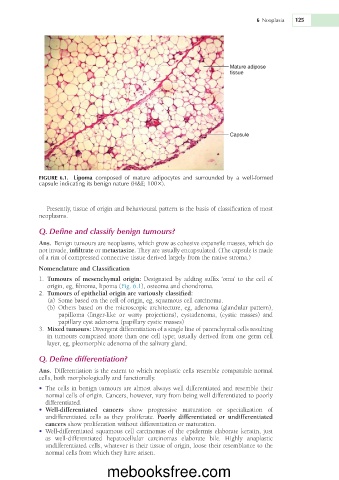
                                                                        Mature adipose
                                                                        tissue


                                                                        Capsule


             FIGURE  6.1.  Lipoma  composed  of  mature  adipocytes  and  surrounded  by  a  well-formed
             capsule indicating its benign nature (H&E; 1003).


               Presently, tissue of origin and behavioural pattern is the basis of classification of most
             neoplasms.

             Q. Define and classify benign tumours?
             Ans.  Benign tumours are neoplasms, which grow as cohesive expansile masses, which do
             not invade, infiltrate or metastasize. They are usually encapsulated. (The capsule is made
             of a rim of compressed connective tissue derived largely from the native stroma.)
             Nomenclature and Classification
               1.  Tumours of mesenchymal origin: Designated by adding suffix ‘oma’ to the cell of
                origin, eg, fibroma, lipoma (Fig. 6.1), osteoma and chondroma.
               2.  Tumours of epithelial origin are variously classified:
                 (a)  Some based on the cell of origin, eg, squamous cell carcinoma.
                 (b)  Others based on the microscopic architecture, eg, adenoma (glandular pattern),
                   papilloma  (finger-like  or  warty  projections),  cystadenoma,  (cystic  masses)  and
                   papillary cyst adenoma (papillary cystic masses)
               3.  Mixed tumours: Divergent differentiation of a single line of parenchymal cells resulting
                in tumours comprised more than one cell type; usually derived from one germ cell
                layer, eg, pleomorphic adenoma of the salivary gland.

             Q. Define differentiation?
             Ans.  Differentiation is the extent to which neoplastic cells resemble comparable normal
             cells, both morphologically and functionally.
             •  The cells in benign tumours are almost always well differentiated and resemble their
               normal cells of origin. Cancers, however, vary from being well differentiated to poorly
               differentiated.
             •  Well-differentiated  cancers  show  progressive  maturation  or  specialization  of
               undifferentiated  cells  as  they  proliferate.  Poorly  differentiated  or  undifferentiated
               cancers show proliferation without differentiation or maturation.
             •  Well-differentiated squamous cell carcinomas of the epidermis elaborate keratin, just
               as  well-differentiated  hepatocellular  carcinomas  elaborate  bile.  Highly  anaplastic
               undifferentiated cells, whatever is their tissue of origin, loose their resemblance to the
               normal cells from which they have arisen.


                                  mebooksfree.com

