


Page 159 - Concise Pathology for Exam Preparation ( PDFDrive )
P. 159
144   SECTION I  General Pathology

                     Q. Write briefly on microbial carcinogenesis.

                     Ans. Carcinogenic microbiological agents mainly include oncogenic DNA and RNA vi-
                     ruses as well as bacteria like Helicobacter pylori.
                       1.  Oncogenic DNA viruses: Genomes of oncogenic DNA viruses integrate into and forms
                        stable associations with host genome, eg, E6 proteins of high-risk HPV types complex
                        with p53 to enhance its degradation. Oncogenic DNA viruses include:
                         (a)  Human  papilloma  virus  (HPV):  HPV  has  more  than  100  distinct  subtypes  of
                           which types 1, 2, 4 and 7 cause benign squamous papillomas or warts. Squamous
                           cell carcinomas (SCCs) of cervix and anogenital region, as well as, oral and laryn-
                           geal cancers are associated with HPV 16, 18, 31, 33, 35 and 51 and their precursor
                           lesions; whereas, HPV 6 and 11 cause genital lesions with low-malignant potential.
                           HPV genome is present in episomal (nonintegrated) form in benign warts and
                           preneoplastic lesions. In cancers, the viral genome appears to be integrated into
                           the host DNA. HPV proteins have the following effects on the cell cycle:
                            •  E6 and E7 block p53 and RB cell-cycle suppression pathways, respectively.
                            •  E6 proteins of high-risk HPV type complex with p53 to enhance its degradation. E6
                              proteins of low-risk HPV types have low affinity for p53 and do not affect its stability.
                            •  Increased p53 degradation causes a block in apoptosis (p53 increases activity of
                              BAX, which is proapoptotic).
                            •  E7 from high-risk types binds to RB protein, releasing sequestered E2F from the
                              RB–E2F complex, triggering entry of cells in the S phase.
                            •  E7 from low-risk types has a lower affinity for RB protein, and is slow in trans-
                              forming cells.
                         (b)  Epstein–Barr virus (EBV): EBV is implicated in the pathogenesis of
                             (i)  African form of Burkitt lymphoma
                            (ii)  B-cell lymphoma in immunosuppressed individuals
                             (iii)  Hodgkin lymphoma
                            (iv)  Nasopharyngeal carcinoma
                            (v)  Gastric carcinoma
                            (vi)  NK cell lymphoma
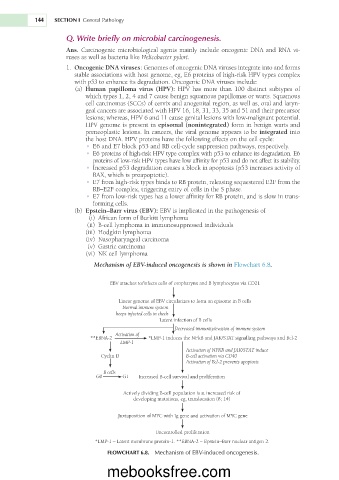
                              Mechanism of EBV-induced oncogenesis is shown in Flowchart 6.8.


                                   EBV attaches to/infects cells of oropharynx and B lymphocytes via CD21

                                      Linear genome of EBV circularizes to form an episome in B cells
                                       Normal immune system
                                     keeps infected cells in check
                                                  Latent infection of B cells
                                                       Decreased immunity/evasion of immune system
                                     Activation of
                             **EBNA-2          *LMP-1 induces the NFkB and JAK/STAT signalling pathways and Bcl-2
                                      LMP-1
                                                          Activation of NFKB and JAK/STAT induce
                                Cyclin D                  B-cell activation via CD40
                                                          Activation of Bcl-2 prevents apoptosis
                                 B cells
                               G0      G1   Increased B-cell survival and proliferation

                                       Actively dividing B-cell population is at increased risk of
                                          developing mutations, eg, translocation (8; 14)

                                     Juxtaposition of MYC with Ig gene and activation of MYC gene

                                                 Uncontrolled proliferation
                              *LMP-1 – Latent membrane protein-1. **EBNA-2 – Epstein–Barr nuclear antigen 2.
                                  FLOWCHART 6.8.  Mechanism of EBV-induced oncogenesis.


                                  mebooksfree.com

