


Page 157 - Concise Pathology for Exam Preparation ( PDFDrive )
P. 157
142   SECTION I  General Pathology


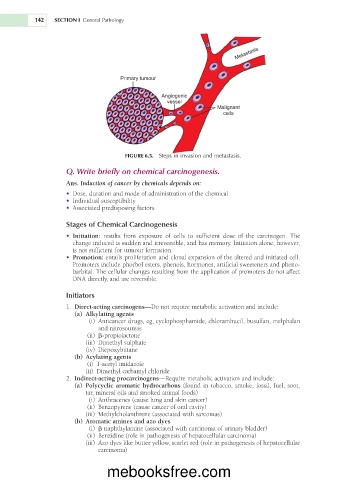
                                                                          Metastasis


                                      Primary tumour


                                                   Angiogenic
                                                    vessel
                                                                    Malignant
                                                                      cells


                                        FIGURE 6.5.  Steps in invasion and metastasis.

                     Q. Write briefly on chemical carcinogenesis.
                     Ans. Induction of cancer by chemicals depends on:
                     •  Dose, duration and mode of administration of the chemical
                     •  Individual susceptibility
                     •  Associated predisposing factors

                     Stages of Chemical Carcinogenesis

                     •  Initiation:  results  from  exposure  of  cells  to  sufficient  dose  of  the  carcinogen.  The
                       change induced is sudden and irreversible, and has memory. Initiation alone, however,
                       is not sufficient for tumour formation.
                     •  Promotion: entails proliferation and clonal expansion of the altered and initiated cell.
                       Promoters include phorbol esters, phenols, hormones, artificial sweeteners and pheno-
                       barbital. The cellular changes resulting from the application of promoters do not affect
                       DNA directly, and are reversible.

                     Initiators
                       1.  Direct-acting carcinogens—Do not require metabolic activation and include:
                          (a)  Alkylating agents
                            (i)  Anticancer drugs, eg, cyclophosphamide, chlorambucil, busulfan, melphalan
                               and nitrosoureas
                            (ii)  b-propiolactone
                           (iii)  Dimethyl sulphate
                           (iv)  Diepoxybutane
                          (b)  Acylating agents
                            (i)  1-acetyl imidazole
                             (ii)  Dimethyl carbamyl chloride
                       2.  Indirect-acting procarcinogens—Require metabolic activation and include:
                          (a)  Polycyclic aromatic hydrocarbons (found in tobacco, smoke, fossil, fuel, soot,
                           tar, mineral oils and smoked animal foods)
                            (i)  Anthracenes (cause lung and skin cancer)
                            (ii)  Benzopyrene (cause cancer of oral cavity)
                           (iii)  Methylcholanthrene (associated with sarcomas)
                          (b)  Aromatic amines and azo dyes
                            (i)  b naphthylamine (associated with carcinoma of urinary bladder)
                            (ii)  Benzidine (role in pathogenesis of hepatocellular carcinoma)
                           (iii)  Azo dyes like butter yellow, scarlet red (role in pathogenesis of hepatocellular
                               carcinoma)


                                  mebooksfree.com

