


Page 160 - Concise Pathology for Exam Preparation ( PDFDrive )
P. 160
6  Neoplasia  145


                 (c)  Hepatitis viruses: 70–80% hepatocellular carcinoma is due to HBV and HCV. Ef-
                   fects of HBV are mainly indirect; it causes chronic liver cell injury, and regenerative
                   hyperplasia (increased pool of cycling cells are at risk for genetic changes). HBV
                   also  encodes  a  regulatory  element  called  HBX  protein,  which  disrupts  normal
                   growth control of infected liver cells by transcriptional activation of an insulin-like
                   growth factor II and receptors for insulin-like growth factor I. It also binds to P53
                   and interferes with its growth-suppressing activities.
                  (d)  Human herpes simplex virus (HHV) 8: HHV 8 has an established role in Kaposi
                   sarcoma, B cell lymphomas and multicentric variant of Castleman disease. HHV-8
                   infects host macrophages and primitive mesenchymal cells, which differentiate into
                   endothelial cells under the influence of several cytokines like IL6, IL8 and MIP.
               2.  Oncogenic RNA viruses:
                •  Retroviruses are the only RNA viruses that seem to have oncogenic potential in hu-
                  mans. They contain ‘reverse transcriptase’, which induces reverse transcription of viral
                  RNA to synthesize viral DNA. The viral DNA moves to host cell nucleus and gets in-
                  corporated in it. The prototypic example of an oncogenic RNA virus is human T cell
                  leukemia virus (HTLV)-1.
                •  HTLV-1  causes  adult  T  cell  leukaemia–lymphoma  (ATLL)  endemic  in  Japan  and
                  Caribbean basin.
                •  It has tropism for CD41 T cells and is transmitted by passage of infected T cells
                  during sexual intercourse, blood product transfusion and breast feeding.
                •  It contains gag, pol and env genes typical of other retroviruses. It also contains ‘TAX’
                  gene, which activates several host cell genes involved in proliferation and differen-
                  tiation of T cells and interferes with DNA repair functions.
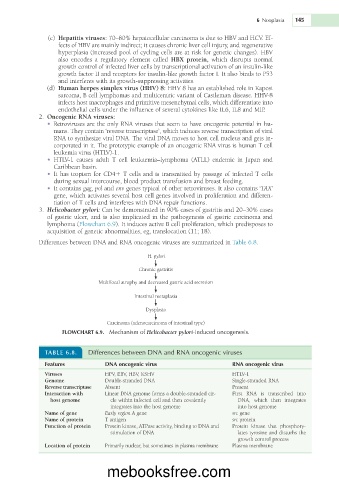
               3.  Helicobacter pylori: Can be demonstrated in 90% cases of gastritis and 20–30% cases
                of gastric ulcer, and is also implicated in the pathogenesis of gastric carcinoma and
                lymphoma (Flowchart 6.9). It induces active B cell proliferation, which predisposes to
                acquisition of genetic abnormalities, eg, translocation (11; 18).
             Differences between DNA and RNA oncogenic viruses are summarized in Table 6.8.

                                               H. pylori
                                            Chronic gastritis

                               Multifocal atrophy and decreased gastric acid secretion
                                          Intestinal metaplasia

                                              Dysplasia

                                  Carcinoma (adenocarcinoma of intestinal type)
                    FLOWCHART 6.9.  Mechanism of Helicobacter pylori-induced oncogenesis.


               TABLE 6.8.   Differences between DNA and RNA oncogenic viruses
               Features          DNA oncogenic virus                     RNA oncogenic virus
               Viruses           HPV, EBV, HBV, KSHV                     HTLV-1
               Genome            Double-stranded DNA                     Single-stranded RNA
               Reverse transcriptase  Absent                             Present
               Interaction with   Linear DNA genome forms a double-stranded cir-  First  RNA  is  transcribed  into
                 host genome       cle within infected cell and then covalently    DNA,  which  then  integrates
                                   integrates into the host genome        into host genome
               Name of gene      Early region A gene                     src gene
               Name of protein   T antigen                               src protein
               Function of protein  Protein kinase, ATPase activity, binding to DNA and   Protein  kinase  that  phosphory-
                                   stimulation of DNA                     lates tyrosine and disturbs the
                                                                          growth control process
               Location of protein  Primarily nuclear, but sometimes in plasma membrane  Plasma membrane


                                  mebooksfree.com

