


Page 158 - Concise Pathology for Exam Preparation ( PDFDrive )
P. 158
6  Neoplasia  143


                 (c)  Naturally occurring products
                    (i)  Aflatoxin B 1  (role in pathogenesis of hepatocellular carcinoma)
                   (ii)  Cycasin (role in hepatobiliary tumours)
                   (iii)  Safrole (carcinogenic and genotoxic)
                   (iv)  Betel nuts (oral cancer)
                  (d) Miscellaneous
                    (i)  Nitrosamines and amides (role in pathogenesis of gastric carcinoma)
                    (ii)  Vinyl chloride monomer (implicated in the pathogenesis of angiosarcoma of liver)
                   (iii)  Asbestosis (may lead to bronchogenic carcinoma and mesothelioma)
                   (iv)  Nickel, lead, cobalt and chromium (cause epidermal hyperplasia and basal
                       cell carcinoma)
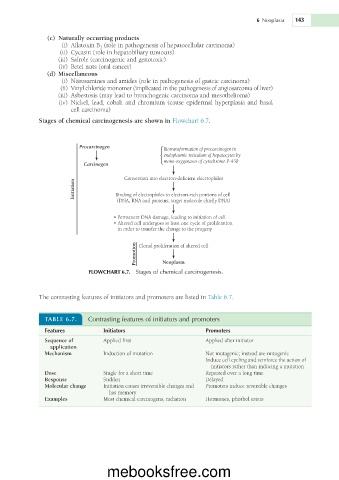
             Stages of chemical carcinogenesis are shown in Flowchart 6.7.


                         Procarcinogen             Biotransformation of procarcinogen in
                                                   endoplasmic reticulum of hepatocytes by
                                                   mono-oxygenases of cytochrome P-450
                           Carcinogen

                                       Conversion into electron-deficient electrophiles
                        Initiation   Binding of electrophiles to electron-rich portions of cell

                                     (DNA, RNA and proteins; target molecule chiefly DNA)

                                    • Permanent DNA damage, leading to initiation of cell
                                    •  Altered cell undergoes at least one cycle of proliferation
                                       in order to transfer the change to the progeny
                                           Promotion  Clonal proliferation of altered cell


                                                   Neoplasm
                            FLOWCHART 6.7.  Stages of chemical carcinogenesis.


             The contrasting features of initiators and promoters are listed in Table 6.7.


               TABLE 6.7.   Contrasting features of initiators and promoters
               Features          Initiators                     Promoters
               Sequence of       Applied first                  Applied after initiator
                 application
               Mechanism         Induction of mutation          Not mutagenic; instead are mitogenic
                                                                Induce cell cycling and reinforce the action of
                                                                  initiators rather than inducing a mutation
               Dose              Single for a short time        Repeated over a long time
               Response          Sudden                         Delayed
               Molecular change  Initiation causes irreversible changes and   Promoters induce reversible changes
                                   has memory
               Examples          Most chemical carcinogens, radiation  Hormones, phorbol esters


                                  mebooksfree.com

