


Page 199 - Concise Pathology for Exam Preparation ( PDFDrive )
P. 199
184   SECTION I  General Pathology


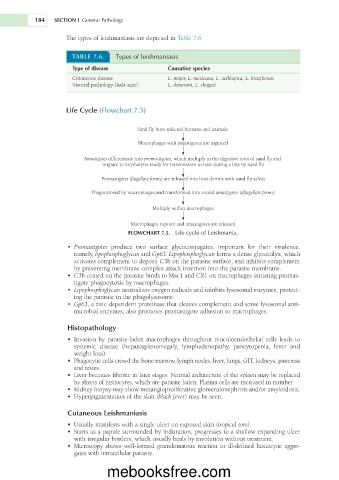
                     The types of leishmaniasis are depicted in Table 7.6.

                       TABLE 7.6.    Types of leishmaniasis
                       Type of disease               Causative species
                       Cutaneous disease             L. major, L. mexicana, L. aethiopica, L. braziliensis
                       Visceral pathology (kala azar)  L. donovani, L. chagasi


                     Life Cycle (Flowchart 7.5)


                                           Sand fly bites infected humans and animals

                                            Macrophages with amastigotes are ingested

                           Amastigotes differentiate into promastigotes, which multiply in the digestive tract of sand fly and

                                 migrate to its pharynx ready for transmission to host during a bite by sand fly
                                Promastigotes (flagellate forms) are released into host dermis with sand fly saliva

                             Phagocytosed by macrophages and transformed into round amastigotes (aflagellate forms)


                                                Multiply within macrophages

                                         Macrophages rupture and amastigotes are released
                                         FLOWCHART 7.5.  Life cycle of Leishmania.

                      •  Promastigotes  produce  two  surface  glycoconjugates,  important  for  their  virulence,
                        namely, lipophosphoglycan and Gp63. Lipophosphoglycan forms a dense glycocalyx, which
                        activates complement to deposit C3b on the parasite surface, and inhibits complement
                        by preventing membrane complex attack insertion into the parasite membrane.
                      •  C3b coated on the parasite binds to Mac1 and CR1 on macrophages initiating promas-
                        tigote phagocytosis by macrophages.
                      •  Lipophosphoglycan neutralizes oxygen radicals and inhibits lysosomal enzymes, protect-
                        ing the parasite in the phagolysosome.
                      •  Gp63, a zinc-dependent proteinase that cleaves complement and some lysosomal anti-
                        microbial enzymes; also promotes promastigote adhesion to macrophages.

                      Histopathology
                      •  Invasion by parasite-laden macrophages throughout reticuloendothelial cells leads to
                        systemic  disease  (hepatosplenomegaly,  lymphadenopathy,  pancytopenia,  fever  and
                        weight loss).
                      •  Phagocytic cells crowd the bone marrow, lymph nodes, liver, lungs, GIT, kidneys, pancreas
                        and testes.
                      •  Liver becomes fibrotic in later stages. Normal architecture of the spleen may be replaced
                        by sheets of histiocytes, which are parasite laden. Plasma cells are increased in number.
                      •  Kidney biopsy may show mesangioproliferative glomerulonephritis and/or amyloidosis.
                      •  Hyperpigmentation of the skin (black fever) may be seen.
                      Cutaneous Leishmaniasis

                      •  Usually manifests with a single ulcer on exposed skin (tropical sore).
                      •  Starts as a papule surrounded by induration, progresses to a shallow expanding ulcer
                        with irregular borders, which usually heals by involution without treatment.
                      •  Microscopy shows well-formed granulomatous reaction or ill-defined histiocytic aggre-
                        gates with intracellular parasite.


                                  mebooksfree.com

