


Page 317 - Concise Pathology for Exam Preparation ( PDFDrive )
P. 317
302    SECTION II  Diseases of Organ Systems


                         Reduced  urinary  excretion  (if  kidney  function  is  normal)  indicates  inadequate
                         vitamin B 12  absorption. Improved absorption with the subsequent addition of intrin-
                         sic factor to radiolabelled vitamin B 12  confirms the diagnosis of pernicious anaemia.
                        The test is often difficult to do or interpret because of incomplete urine collection or
                     renal insufficiency. In addition, because the Schilling test does not measure absorption of
                     protein-bound vitamin B 12 , the test does not detect defective liberation of vitamin B 12  from
                     foods, which is common among the elderly.
                        If the malabsorption is identified, the Schilling test can be repeated after a 2-week trial
                     of an oral antibiotic. If antibiotic therapy corrects malabsorption, the likely cause is intes-
                     tinal overgrowth of bacteria (eg, blind-loop syndrome).

                     Q. Write briefly on anaemia due to blood loss.
                     Ans.

                     Anaemia due to acute blood loss:
                     •  A healthy adult tolerates a loss of about 500 mL of whole blood without any ill effects.
                     •  When more is lost, compensatory mechanisms come into play (the blood flow to skin and
                       skeletal muscle is reduced, conserving the blood flow to vital organs like brain, kidney and
                       heart.)  If  bleeding  continues,  compensatory  mechanisms  fail  and  hypovolaemic  shock
                       develops.
                     •  Most expansion of plasma volume is seen in the first 24 h of blood loss.

                     Anaemia due to Chronic Blood Loss

                     Compensatory mechanisms replenish the plasma volume and red cell loss. However, if the
                     blood loss continues, body iron stores are depleted and anaemia due to iron deficiency appears.

                     Q.  Define  normocytic  normochromic  anaemia  and  enumerate  its
                     causes.

                     Ans.  Normocytic  normochromic  anaemia  is  characterized  by  normal  size  of  RBCs
                     (normal MCV) and normal haemoglobinization (MCH).
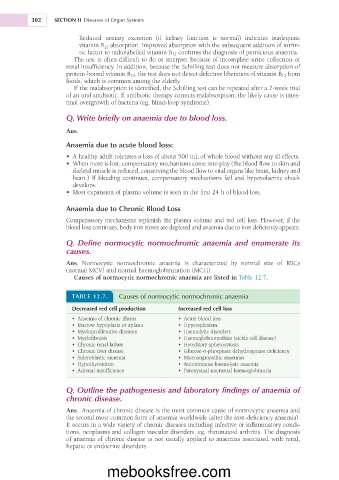
                        Causes of normocytic normochromic anaemia are listed in Table 12.7.

                       TABLE 12.7.    Causes of normocytic normochromic anaemia

                       Decreased red cell production    Increased red cell loss
                       •  Anaemia of chronic illness    •  Acute blood loss
                       •  Marrow hypoplasia or aplasia  •  Hypersplenism
                       •  Myeloproliferative diseases   •  Haemolytic disorders
                       •  Myelofibrosis                 •  Haemoglobinopathies (sickle cell disease)
                       •  Chronic renal failure         •  Hereditary spherocytosis
                       •  Chronic liver disease         •  Glucose-6-phosphate dehydrogenase deficiency
                       •  Sideroblastic anaemia         •  Microangiopathic anaemias
                       •  Hypothyroidism                •  Autoimmune haemolytic anaemia
                       •  Adrenal insufficiency         •  Paroxysmal nocturnal haemoglobinuria

                     Q. Outline the pathogenesis and laboratory findings of anaemia of
                     chronic disease.
                     Ans.  Anaemia of chronic disease is the most common cause of normocytic anaemia and
                     the second most common form of anaemia worldwide (after the iron-deficiency anaemia).
                     It occurs in a wide variety of chronic diseases including infective or inflammatory condi-
                     tions, neoplasms and collagen vascular disorders, eg, rheumatoid arthritis. The diagnosis
                     of anaemia of chronic disease is not usually applied to anaemias associated with renal,
                     hepatic or endocrine disorders.


                                  mebooksfree.com

