


Page 322 - Concise Pathology for Exam Preparation ( PDFDrive )
P. 322
12  Haematology  307


                                                G6PD
                         Glucose-6-phosphate                6-phosphogluconate
                                              2GSH    NADP
                                                       NADPH
                                  Glutathione         Glutathione
                                    peroxidase        reductase
                                              GSSG
                         H O                                        H O
                          2 2
                                                                      2
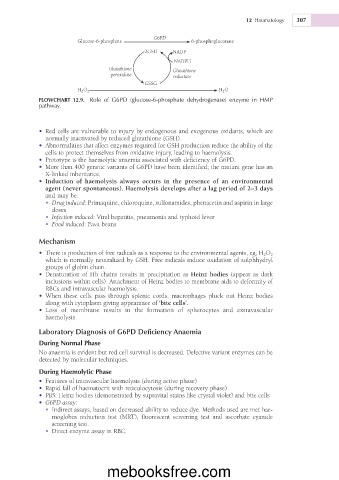
             FLOWCHART  12.9.  Role  of  G6PD  (glucose-6-phosphate  dehydrogenase)  enzyme  in  HMP
             pathway.

             •  Red cells are vulnerable to injury by endogenous and exogenous oxidants, which are
               normally inactivated by reduced glutathione (GSH).
             •  Abnormalities that affect enzymes required for GSH production reduce the ability of the
               cells to protect themselves from oxidative injury, leading to haemolysis.
             •  Prototype is the haemolytic anaemia associated with deficiency of G6PD.
             •  More than 400 genetic variants of G6PD have been identified; the mutant gene has an
               X-linked inheritance.
             •  Induction  of  haemolysis  always  occurs  in  the  presence  of  an  environmental
               agent (never spontaneous). Haemolysis develops after a lag period of 2–3 days
               and may be:
               •  Drug	induced: Primaquine, chloroquine, sulfonamides, phenacetin and aspirin in large
                 doses
               •  Infection	induced: Viral hepatitis, pneumonia and typhoid fever
               •  Food	induced:	Fava beans


             Mechanism
             •  There is production of free radicals as a response to the environmental agents, eg, H 2 O 2
               which is normally neutralized by GSH. Free radicals induce oxidation of sulphhydryl
               groups of globin chain.
             •  Denaturation of Hb chains results in precipitation as Heinz  bodies (appear as dark
               inclusions within cells). Attachment of Heinz bodies to membrane aids to deformity of
               RBCs and intravascular haemolysis.
             •  When  these  cells  pass  through  splenic  cords,  macrophages  pluck  out  Heinz  bodies
               along with cytoplasm giving appearance of ‘bite cells’.
             •  Loss  of  membrane  results  in  the  formation  of  spherocytes  and  extravascular
               haemolysis.

             Laboratory Diagnosis of G6PD Deficiency Anaemia
             During Normal Phase
             No anaemia is evident but red cell survival is decreased. Defective variant enzymes can be
             detected by molecular techniques.

             During Haemolytic Phase
             •  Features of intravascular haemolysis (during active phase)
             •  Rapid fall of haematocrit with reticulocytosis (during recovery phase)
             •  PBS: Heinz bodies (demonstrated by supravital stains like crystal violet) and bite cells
             •  G6PD	assay:
               •  Indirect assays, based on decreased ability to reduce dye. Methods used are met hae-
                 moglobin  reduction  test  (MRT),  fluorescent  screening  test  and  ascorbate  cyanide
                 screening test.
               •  Direct enzyme assay in RBC.


                                  mebooksfree.com

