


Page 312 - Concise Pathology for Exam Preparation ( PDFDrive )
P. 312
12  Haematology  297


                 (b)  Passive mechanism
                     (i)  No carrier molecule involved
                    (ii)  Seen with supraphysiological doses of vitamin B 12
                     (iii)  Absorption occurs through the buccal, gastric and jejuna mucosa
             	3.	 Transportation	of	Vitamin	B 12 : Cobalamin is a general term for compounds with bio-
                logic vitamin B 12  activity. These compounds are involved in nucleic acid metabolism,
                methyl transfer, myelin synthesis and repair. They are necessary for the formation of
                normal RBCs. Cobalmin has a transport form (methylcobalamin) and a storage form
                (adenosylcobalamin).  There  are  three  major  vitamin  B 12 -binding  proteins  in  plasma
                namely transcobalamins I, II and III.
               Transcobalamin	I	(Haptocorrin)
                •  a-1 Globulin synthesized by granulocytes
                •  70–80% of endogenous B 12  is bound to TC I
                •  Required for storage and not essential for transport; therefore, its absence does not
                  lead to clinical signs of B 12  deficiency
               Transcobalamin	II
                •  b-Globulin synthesized in liver
                •  Essential for transport of B 12  from organ to organ and from cell to cell (B 12  bound to
                  TC II is known as holotranscobalmin or holo-TC)
                •  Deficiency leads to severe megaloblastic anaemia
               Transcobalamin	III
                •  Binds a small amount of B 12
               4.	 Storage	of	B 12
                 (a)  The liver stores large amounts of vitamin B 12  followed by the kidneys, heart and brain.
                 (b)  B 12  is excreted through bile and shedding of intestinal epithelial cells (enterohe-
                   patic reabsorption helps to retain vitamin B 12 ).
               5.  Functions	of	B 12
                (a) Methylmalonyl CoA
                          • Methylmalonyl CoA mutase
                          • Adenosylcobalamin (B )
                                            12
                    Succinyl CoA

                (b)            Homocysteine
                    FH4
                         Methyl group
                                    Methylcobalamin
                   N5-methyl-THF
                              Methionine           dUMP
                        FH4         N5, 10-methylene FH4

                                                   dTMP       DNA
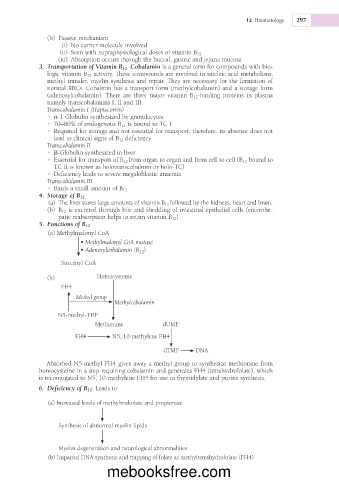
               Absorbed N5-methyl FH4 gives away a methyl group to synthesize methionine from
             homocysteine in a step requiring cobalamin and generates FH4 (tetrahydrofolate), which
             is reconjugated to N5, 10-methylene FH4 for use in thymidylate and purine synthesis.
             	6.	 Deficiency	of	B 12 : Leads to

                (a) Increased levels of methylmalonate and propionate


                   Synthesis of abnormal myelin lipids


                   Myelin degeneration and neurological abnormalities
                (b) Impaired DNA synthesis and trapping of folate as methyltetrahydrofolate (FH4)

                                  mebooksfree.com

